Posts
Reunification Palace
The Reunification Palace in Saigon, Vietnam
Known as Independence Palace before the fall of Saigon to communists, the Reunification Palace was home and command center of General Nguyen Van Thieu – head of a military junta who came to power after the first President of South Vietnam was assassinated in 1963.
The Reunification Palace was the site of a dramatic finish to the Vietnam War as tanks crashed through the main gate on the morning of April 30, 1975. Today, the Reunification Palace is a time capsule unchanged since the 1970s – a must-see in Ho Chi Minh City.
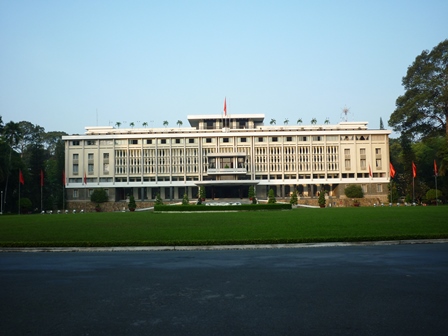
Today
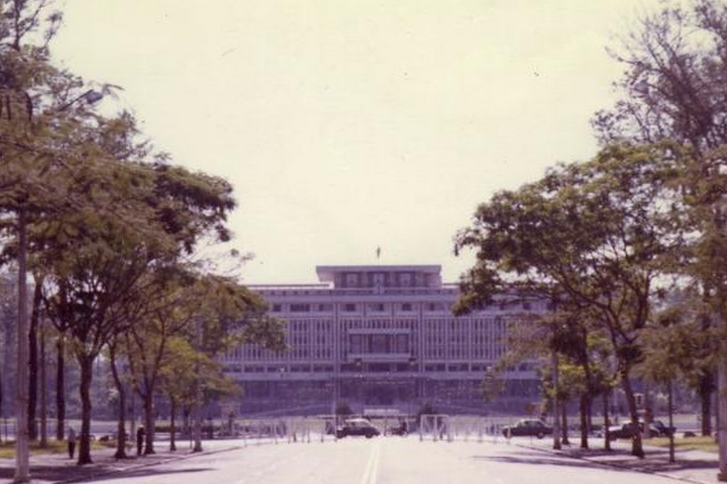
1970
Visiting the Reunification Palace
Open Hours: Daily from 7:30 a.m. to 4 p.m. The ticket window closes daily between 11 a.m. and 1 p.m. The palace closes sporadically for special events and visits from VIPs.
Entrance Fee: 75 cents.
Other Concerns
- An entrance ticket must be purchased at the main gate.
- All visitors must pass through security and have bags screened. Dangerous objects such as pocketknives are not permitted.
- Small backpacks are allowed inside, however larger luggage must be left at security.
- Smoking is prohibited inside the Reunification Palace.
- Do not walk on the grass or touch displays around the palace.
Tour Guides
There are very few signboards or explanations of rooms and displays – an English-speaking guide will greatly enhance your visit. Free tour guides can be arranged in the lobby or you may join a group already in progress.
What to Expect
Attractions inside of the airy palace interior are pretty sparse. Roped-off rooms such as the presidential office, receiving room, and bedroom appear musky and grim with antique furniture and bare walls. A highlight of the Reunification Palace is found in the basement which includes a command bunker with old radio equipment and strategy maps on the walls. After exiting the basement into the courtyard, there is a room filled with historic photos – heavily sprinkled with propaganda – portraying the fall of the Independence Palace.
A climb to the fourth floor rooftop yields some nice views of the palace grounds as well as an old US UH-1 helicopter. The rooftop was used as a helipad for evacuating staff just before the palace was overrun.
Before exiting the gate, check out two of the original Russian T-54 tanks – used in the capture of the palace – parked on the lawn.
History of the Reunification Palace
Norodom Palace – the French colonial headquarters in Saigon – was built in 1873 and occupied by the first president of South Vietnam until two rogue pilots dropped bombs on the structure during an assassination attempt in 1962. One bomb actually fell into the wing where President Diem was reading, but failed to detonate! President Diem ordered the damaged palace to be demolished and enlisted the help of renowned architect Ngo Viet Thu to build what is now the Reunification Palace.
President Diem was assassinated in 1963 before construction of the new palace was completed. General Nguyen Van Thieu – head of a military junta – moved into the completed palace in 1967 to serve as the second president of South Vietnam; he changed the name to Independence Palace.
Independence Palace served as central command for the South Vietnamese effort against communist forces until April 21, 1975 when General Thieu was evacuated as part of Operation Frequent Wind – the largest helicopter evacuation in history.
On April 30, 1975 North Vietnamese forces captured the palace and later renamed it Reunification Palace.
Order of Battle – Vietnam
What is the Order of Battle?
The organization or hierarchy of military forces in preparation for a battle.
The planned sequence in which military units arrive and are deployed on a battlefield,
usually based on estimates of their combat effectiveness.
Let’s take a look at the organization or hierarchy of the 4th Infantry Division during Vietnam. Continue reading
TET 1968
The 1st Battalion, 22nd Infantry was awarded the Valorous Unit Citation for its actions in the defense of the Provincial Capital of Kontum, during the Tet Offensive of 1968.

.
Basic Training, Gas Chamber
Basic Training, Gas Chamber-Do it Right!
It really is as bad as it looks.
Battle of Khe Sanh – Bombing Runs
Vietnam – Battle of Khe Sanh – Bombing Runs – B-52’s – 1967 to 1968 Air Power
The Spy in the Hanoi Hilton
In 1973, 591 American POWs returned home from the Vietnam War, bringing with them harrowing tales of survival. But there was an even more remarkable — and secret — story to tell: a feat of incredible spycraft that remained classified for decades…until now. This is the unbelievable story of James Stockdale and his fellow prisoners at the notorious “Hanoi Hilton.” Their clandestine communications with U.S. intelligence alerted the CIA and Pentagon to the horrors of the Vietnamese POW camps and prompted a daring, top-secret rescue mission.
Click for the Story
Vietnam Wall Facts
Freedom is never more than one generation away from extinction. We didn’t pass it to our children in the bloodstream. It must be fought for, protected, and handed on for them to do the same.
~ Ronald Reagan
These are amazing – and heartbreaking – facts! A little history most people will never know.
Interesting Veterans Statistics off the Vietnam Memorial Wall.
- There are 58,267 names now listed on that polished black wall, including those added in 2010.
- The names are arranged in the order in which they were taken from us by date and within each date the names are alphabetized. It is hard to believe it is 57 years since the first casualty.
- The first known casualty was Richard B. Fitzgibbon, of North Weymouth, Mass. Listed by the U.S. Department of Defense as having been killed on June 8, 1956. His name is listed on the Wall with that of his son, Marine Corps Lance Cpl. Richard B. Fitzgibbon III, who was killed on Sept. 7, 1965.
- There are three sets of fathers and sons on the Wall.
- 39,996 on the Wall were just 22 or younger.
- 8,283 were just 19 years old.
- The largest age group, 33,103 were 18 years old.
- 12 soldiers on the Wall were 17 years old.
- 5 soldiers on the Wall were 16 years old.
- One soldier, PFC Dan Bullock was 15 years old.
- 997 soldiers were killed on their first day in Vietnam.
- 1,448 soldiers were killed on their last day in Vietnam.
- 31 sets of brothers are on the Wall.
- Thirty one sets of parents lost two of their sons.
- 54 soldiers attended Thomas Edison High School in Philadelphia. I wonder why so many from one school.
- 8 Women are on the Wall, Nursing the wounded.
- 244 soldiers were awarded the Medal of Honor during the Vietnam War; 153 of them are on the Wall.
- Beallsville, Ohio with a population of 475 lost 6 of her sons.
- West Virginia had the highest casualty rate per capita in the nation. There are 711 West Virginians on the Wall.
- The Marines of Morenci – They led some of the scrappiest high school football and basketball teams that the little Arizona copper town of Morenci (pop. 5,058) had ever known and cheered. They enjoyed roaring beer busts. In quieter moments, they rode horses along the Coronado Trail, stalked deer in the Apache National Forest. And in the patriotic camaraderie typical of Morenci’s mining families, the nine graduates of Morenci High enlisted as a group in the Marine Corps. Their service began on Independence Day, 1966. Only 3 returned home.
- The Buddies of Midvale – LeRoy Tafoya, Jimmy Martinez, Tom Gonzales were all boyhood friends and lived on three consecutive streets in Midvale, Utah on Fifth, Sixth and Seventh avenues. They lived only a few yards apart. They played ball at the adjacent sandlot ball field. And they all went to Vietnam. In a span of 16 dark days in late 1967, all three would be killed. LeRoy was killed on Wednesday, Nov. 22, the fourth anniversary of John F. Kennedy’s assassination. Jimmy died less than 24 hours later on Thanksgiving Day. Tom was shot dead assaulting the enemy on Dec. 7, Pearl Harbor Remembrance Day.
- The most casualty deaths for a single day was on January 31, 1968 ~ 245 deaths.
- The most casualty deaths for a single month was May 1968 – 2,415 casualties were incurred.
For most Americans who read this they will only see the numbers that the Vietnam War created. To those of us who survived the war, and to the families of those who did not, we see the faces, we feel the pain that these numbers created. We are, until we too pass away, haunted with these numbers, because they were our friends, fathers, husbands, wives, sons and daughters. There are no noble wars, just noble warriors.
For God and Country
John Spagnoletti
Post Adjutant
Thanks to Doc for the information. Hooah.
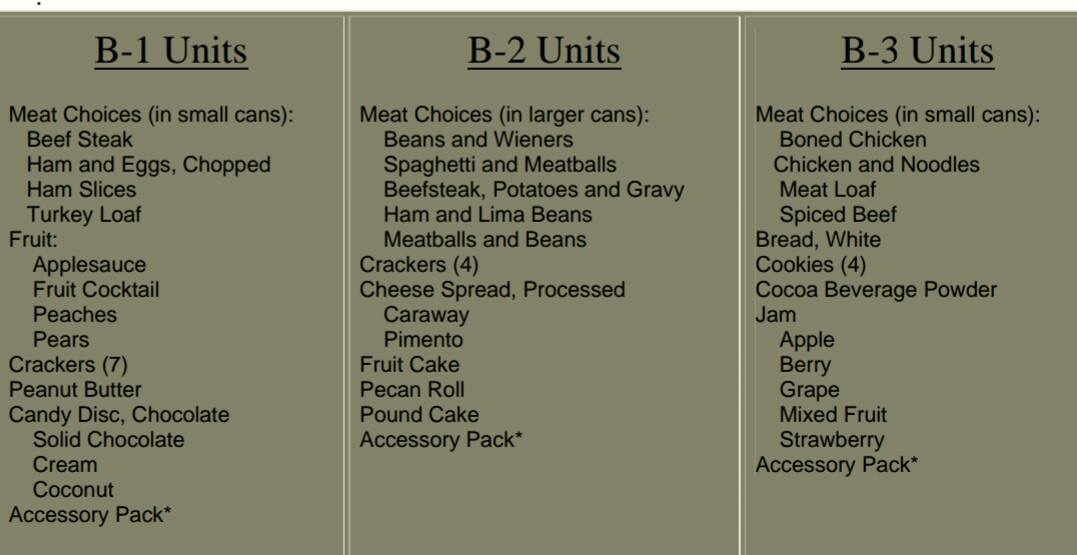
 Charlie Company Vietnam 1966-1972