Thank You Soldier

Story and photo provided by The Polk County Pulse Newspaper

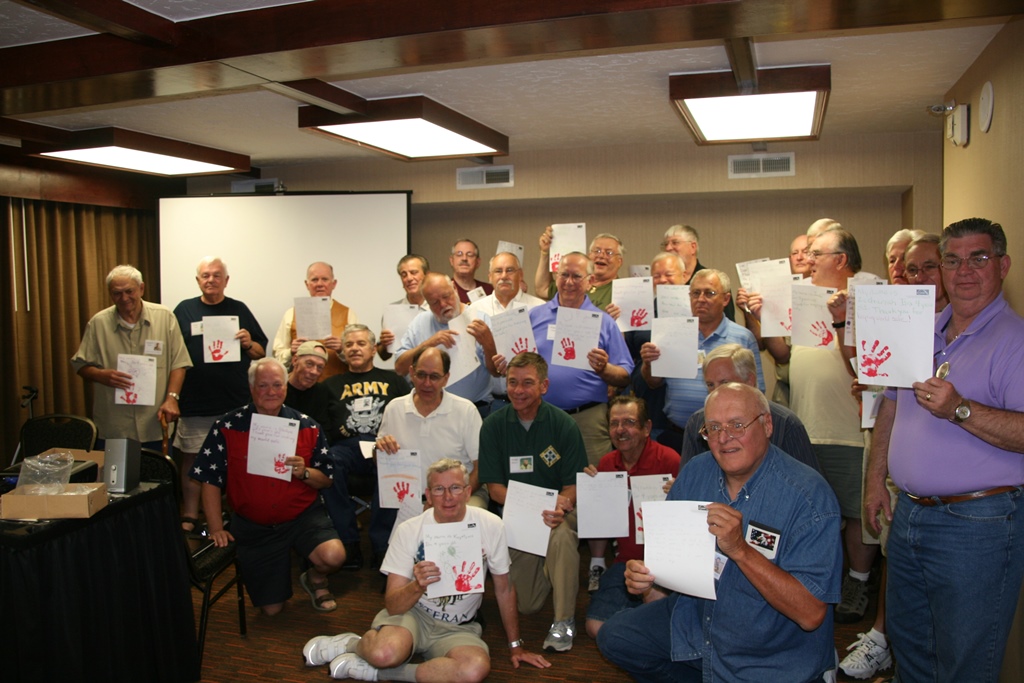
RAYMOND WARNER (kneeling bottom right), a local Vietnam Veteran, recently attended his 4th Infantry Reunion in Tulsa. He personally delivered “Thank You Soldier” notes that had been made by the children of The Crossing Church to the combat veterans. Many, still having memories of being spat upon when they returned from the war, were deeply moved by the children’s efforts acknowledging their service to their country.  Most attending were Purple Heart Recipients.

“Greater love has no one than this, that one lay down his life for his friends.” – John 15:13

R Warner

Reckless

Reckless was a pack horse during the Korean war, and she carried recoil-less rifles, ammunition and supplies to Marines. Nothing too unusual about that, lots of animals got pressed into doing pack chores in many wars.

But this horse did something more… during the battle for a location called Outpost Vegas, this mare made 50 trips up and down the hill, on the way up she carried ammunition, and on the way down she carried wounded soldiers…

So what was so amazing?

Well she made every one of those trips through enemy fire and without anyone leading her.

Here’s her story and photos to prove where she was and what she did.

CLICK HERE

Vietnam Economy

Economy

Vietnam is a densely-populated developing country that in the last 30 years has had to recover from the ravages of war, the loss of financial support from the old Soviet Bloc, and the rigidities of a centrally-planned economy.

Economic stagnation marked the period after reunification from 1975 to 1985. In 1986, the Sixth Party Congress approved a broad economic reform package that introduced market reforms and set the groundwork for Vietnam’s improved investment climate. Substantial progress was achieved from 1986 to 1997 in moving forward from an extremely low level of development and significantly reducing poverty.

The 1997 Asian financial crisis highlighted the problems in the Vietnamese economy and temporarily allowed opponents of reform to slow progress toward a market-oriented economy. GDP growth averaged 6.8% per year from 1997 to 2004 even against the background of the Asian financial crisis and a global recession.

Since 2001, Vietnamese authorities have reaffirmed their commitment to economic liberalization and international integration. They have moved to implement the structural reforms needed to modernize the economy and to produce more competitive, export-driven industries. The economy grew 8.5% in 2007. Vietnam’s membership in the ASEAN Free Trade Area (AFTA) and entry into force of the US-Vietnam Bilateral Trade Agreement in December 2001 have led to even more rapid changes in Vietnam’s trade and economic regime. Vietnam’s exports to the US increased 900% from 2001 to 2007.

Vietnam joined the WTO in January 2007, following over a decade long negotiation process. WTO membership has provided Vietnam an anchor to the global market and reinforced the domestic economic reform process. Among other benefits, accession allows Vietnam to take advantage of the phase-out of the Agreement on Textiles and Clothing, which eliminated quotas on textiles and clothing for WTO partners on 1 January 2005. Agriculture’s share of economic output has continued to shrink, from about 25% in 2000 to less than 20% in 2007.

Deep poverty, defined as a percent of the population living under $1 per day, has declined significantly and is now smaller than that of China, India, and the Philippines. Vietnam is working to create jobs to meet the challenge of a labor force that is growing by more than one-and-a-half million people every year. In an effort to stem high inflation which took off in 2007, early in 2008 Vietnamese authorities began to raise benchmark interest rates and reserve requirements. Hanoi is targeting an economic growth rate of 7.5-8% during the next four years.

GDP: $221.1 billion (2007 est.)
GDP growth rate: 8.5%
GDP per capita: $2,600
GDP composition by sector: agriculture: 20.9%
industry: 41%
services: 38.1%
Inflation rate: 8.3%
Labor force: 44.39 million
Labor force – by occupation: agriculture: 56.8%
industry: 37%
services: 6.2%
Unemployment: 2.4%
Budget: revenues: $11.64 billion
expenditures: $12.95 billion
Electricity production by source: fossil fuel: 43.7%
hydro: 56.3%
Industries: food processing, garments, shoes,   machine-building, mining, cement, chemical fertilizer, glass, tires, oil,   coal, steel, paper
Agriculture: paddy rice, corn, potatoes,   rubber, soybeans, coffee, tea, bananas, sugar; poultry, pigs, fish
Exports: crude oil, marine products, rice,   coffee, rubber, tea, garments, shoes
Export partners: US 21.3%, Japan 13.4%, Australia   8.1%, China 7.5%, Singapore 5.4%, Germany 5.1%
Imports: machinery and equipment, petroleum   products, fertilizer, steel products, raw cotton, grain, cement, motorcycles
Import partners: China 15.5%, Singapore 12.2%,   Taiwan 11.3%, South Korea 10.7%, Japan 9.9%, Thailand 6.5%
Currency: dong (VND)

SOURCES: The CIA World Factbook, U.S. Department of State, Area Handbook of the US Library of Congress

Vietnam Government

Government

Country name: conventional long form: Socialist   Republic of Vietnam
local short form: Viet Nam
abbreviation: SRV
local long form: Cong Hoa Xa Hoi Chu Nghia Viet Nam
Government type: Communist state
Capital: Hanoi
Administrative divisions: 58 provinces (tinh, singular and   plural), and 3 municipalities (thu do, singular and plural)
Independence: 2 September 1945 (from France)
National holiday: Independence Day, 2 September   (1945)
Constitution: 15 April 1992
Legal system: based on communist legal theory   and French civil law system
Suffrage: 18 years of age; universal
Executive branch: chief of state: President Nguyen   Minh TRIET; Vice President Nguyen Thi DOAN
head of government: Prime Minister Nguyen Tan DUNG; Permanent Deputy Prime   Minister Nguyen Sinh HUNG, Deputy Prime Minister Hoang Trung HAI, Deputy   Prime Minister Nguyen Thien NHAN, Deputy Prime Minister Pham Gia KHIEM, and   Deputy Prime Minister Truong Vinh TRONG
cabinet: Cabinet appointed by president based on proposal of prime minister   and confirmed by National Assembly
elections: president elected by the National Assembly from among its members   for five-year term; prime minister appointed by the president from among the   members of the National Assembly; deputy prime ministers appointed by the   prime minister; appointment of prime minister and deputy prime ministers   confirmed by National Assembly
Legislative branch: unicameral National Assembly or   Quoc-Hoi (498 seats; members elected by popular vote to serve five-year   terms)
Judicial branch: Supreme People’s Court (chief   justice is elected for a five-year term by the National Assembly on the   recommendation of the president)

SOURCES: The CIA World Factbook, U.S. Department of State, Area Handbook of the US Library of Congress

Population of Vietnam

Population of Vietnam

Population: 86,116,560 (July 2008 est.)
Age structure: 0-14 years: 27% (male   11,826,457/female 10,983,069)
15-64 years: 67.1% (male 28,055,941/female 28,614,553)
65 years and over: 5.8% (male 1,924,562/female 2,998,384)
Median age: 25.9 years
Growth rate: 1.02%
Infant mortality: 25.14 deaths/1,000 live births
Life expectancy at birth: total population: 70.85 years
male: 68.05 years
female: 73.85 years
Fertility rate: 1.91 children born/woman
Nationality: noun: Vietnamese (singular and   plural)
adjective: Vietnamese
Ethnic groups: Vietnamese 85%-90%, Chinese,   Hmong, Thai, Khmer, Cham, mountain groups
Religions: Buddhist, Hoa Hao, Cao Dai,   Christian (predominantly Roman Catholic, some Protestant), indigenous   beliefs, Muslim
Languages: Vietnamese (official), English   (increasingly favored as a second language), some French, Chinese, and Khmer;   mountain area languages (Mon-Khmer and Malayo-Polynesian)
Literacy: definition: age 15 and over can   read and write
total population: 94%
male: 95.8%
female: 92.3%

SOURCES: The CIA World Factbook, U.S. Department of State, Area Handbook of the US Library of Congress

Geography of Vietnam

Geography of Vietnam

Location: Southeastern Asia, bordering the   Gulf of Thailand, Gulf of Tonkin, and South China Sea, alongside China, Laos,   and Cambodia
Coordinates: 16 00 N, 106 00 E
Area: total: 329,560 sq km
land: 325,360 sq km
water: 4,200 sq km
Area comparative: slightly larger than New Mexico
Land boundaries: total: 4,639 km
border countries: Cambodia 1,228 km, China 1,281 km, Laos 2,130 km
Coastline: 3,444 km (excludes islands)
Maritime claims: contiguous zone: 24 NM
territorial sea: 12 NM
continental shelf: 200 NM or to the edge of the continental margin
exclusive economic zone: 200 NM
Climate: tropical in south; monsoonal in   north with hot, rainy season (mid-May to mid-September) and warm, dry season   (mid-October to mid-March)
Terrain: low, flat delta in south and   north; central highlands; hilly, mountainous in far north and northwest
Elevation extremes: lowest point: South China Sea 0 mhighest point: Fan Si Pan 3,144 m
Natural resources: phosphates, coal, manganese,   bauxite, chromate, offshore oil and gas deposits, forests, hydropower
Natural hazards: occasional typhoons (May to   January) with extensive flooding, especially in the Mekong River delta
Environment current issues: logging and slash-and-burn   agricultural practices contribute to deforestation and soil degradation;   water pollution and overfishing threaten marine life populations; groundwater   contamination limits potable water supply; growing urban industrialization   and population migration are rapidly degrading environment in Hanoi and Ho   Chi Minh City
Geography – note: extending 1,650 km north to south,   the country is only 50 km across at its narrowest point

SOURCES: The CIA World Factbook, U.S. Department of State, Area Handbook of the US Library of Congress

The American Grunt

To the dirt-eating grunt, Vietnam was an endless succession of bummers. Besides the never-ending fear of death, we had to endure a host of miseries: merciless humps through a sun-scorched landscape packing eighty pregnant pounds, brain-boiling heat, hot house humidity, dehydration, heat exhaustion, sunburn, red dust, torrential rains, boot-sucking mud, blood-sucking leeches, steaming jungles, malaria, dysentery, razor sharp elephant grass, bush sores, jungle rot, moaning and groaning, meals in green cans, armies of insects, fire ants, poisonous centipedes, mosquitoes, flies, bush snakes, vipers, scorpions, rats, boredom, incoming fire, body bags; and a thousand more discomforts. Despite all this the grunt did his job well.

The greatest defeat that the United States has suffered in any war was the failure to overcome the attitude of coldness, and indifference, with which Americans shunned most of those returning veterans.

Let us never forget the men and women who served our country so valiantly and at such cost-in the difficult, much-repudiated and unforgettable Vietnam War.

The work of the grunt was unnoticed by the average American. But to the men they worked with in the field, the men that shared life and death on a daily basis he was respected and honored.

Fast Freddy says:

And that… is the essence of Charlie Company.  Hoo-Rah

Our Bequest

OUR BEQUEST

As we of this century

Fade into the morning mist of the next,

We bequeath to you who follow

A place of freedom,

For you to protect and cherish,

As we did in the muddy trenches

And foxholes in our time.

We bequeath to you

Tokens of our sacrifices,

In stone and stories,

Of our love of country,

These are for you, since

We will be beyond caring.

Your who in honoring us,

Will thus shape your own lives.

As the final fragments

Of our once invincible band of brothers,

Slip into darkness one by one,

You of this century,

Accept our legacy,

And guard it carefully.

This gift, more precious than life itself,

Is our bequest.

 – ANON –