
American Veterans
American Veterans
The Vietnam conflict impacted veterans in a variety of ways. Most combat soldiers witnessed violence and lost friends to the horrors of war. The dedication of eight new names to the Vietnam War Memorial on 28 May 2001 brought the American death toll to 58,226, a number that will continue to rise as the classified casualties of the covert war in Laos and Cambodia continue to surface. Some American veterans bore emotional and physical injuries that they would carry for the rest of their lives. Most remained proud of their service and of the role of the United States in the conflict. During the war approximately twenty-seven million American men dealt with the draft; 11 percent of them served in some fashion in Vietnam. As a consequence of college deferments, most U.S. soldiers in Vietnam came from minority and working-class backgrounds. The average age of U.S. soldiers in Vietnam, nineteen, was three years lower than for American men during World War II and Korea. Continue reading
Charlie Shyab Receives Bronze Star
Charlie “Doc” Shyab receives The Bronze Star Medal with “V” device.
Charlie’s Bronze Star with “V” device was official August 1, 2012.
The award reads in part…
Valorous achievement from 26 April 1968 to 28 April 1968, while serving as the Senior Medic with Company C, 1st Infantry Battalion, 22d infantry Regiment, 4th Infantry Division, while serving in the Republic of Vietnam. During the Battle of Chu Moor Mountain, Specialist Four Shyab personally treated multiple casualties, while his unit was in continuous contact with the enemy. During the engagement, he repeatedly exposed himself to small arms, enemy sniper and mortar fire in order to move forward to help wounded Soldiers. While treating casualties, he was seriously wounded by enemy fire and forced to be evacuated. His actions served as great inspiration to his fellow Soldiers in the unit and saved many lives.

Charlie joins the distinguished recipients of the Bronze Star listed below:
Chesty Puller Chuck Yeager David Petraeus Douglas MacArthur George S. Patton James Stockdale John McCain Norman Schwarzkopf, Jr. Tommy Franks William Westmoreland*********************************************
American Forces Press Service
Veterans Awarded Overdue Bronze Star Medals
By Terri Moon Cronk
FORT MEADE, Md., Nov. 9, 2012 – As the nation approaches Veterans Day, observed Nov. 11, two former service members — one from World War II, the other from the Vietnam War — were awarded their long-awaited Bronze Star medals in a ceremony at the Defense Information School here today.
Keynote speaker U.S. Sen. Barbara A. Mikulski of Maryland had worked to ensure that former Army doctor Capt. Charles E. Rath Jr. and former Army medic Spc. 4 Charles Shyab received their medals.
Mikulski presented the awards to the veterans, along with flags that had flown over the U.S. Capitol, at the ceremony.
Misplaced paperwork was the cause of Rath waiting 67 years and Shyab 44 years for their medals.
Shyab’s Bronze Star for valor was authorized in 1968 after he saved many American soldiers’ lives and was wounded on Chu Moor Mountain in Vietnam near Ho Chi Minh Trail.
“This Veterans Day and every day, we are thankful for the service and sacrifice of all our veterans and their families,” Mikulski said. “Our veterans who fought for our freedom shouldn’t have to fight for the recognition they have earned. I went to work to cut through the red tape and break through the bureaucracy to give these two heroes the long-overdue honor they deserve.”
“Here at the Defense Information School,” she continued, “we’re demonstrating that a grateful nation never forgets.”
Mikulski described the ceremony as “very poignant and well-deserved.” Shyab and Rath, she added, “deserve these medals, but also our gratitude.”
Shyab, 68, said he was in one of three companies ordered to ascend Chu Moor Mountain, where Vietnam, Laos and Cambodia meet. They faced a battalion of enemy forces.
“We were in [the enemy’s] backyard,” he said of the fight that April day in 1968. “Once they found out we were there, they started mortaring us and when our place went over to drop a 500-pounder, they used that noise to mortar us and that’s when I got wounded.” Shyab said the soldier who got him safely to a helicopter for evacuation never made it back to his foxhole.
Thirty men were killed in action during that firefight, Shyab said, another 70 were wounded and 15 were evacuated off the mountain. Shyab said he doesn’t recall how many lives he saved that day.
“The men we lost will always be remembered,” he said during the ceremony.
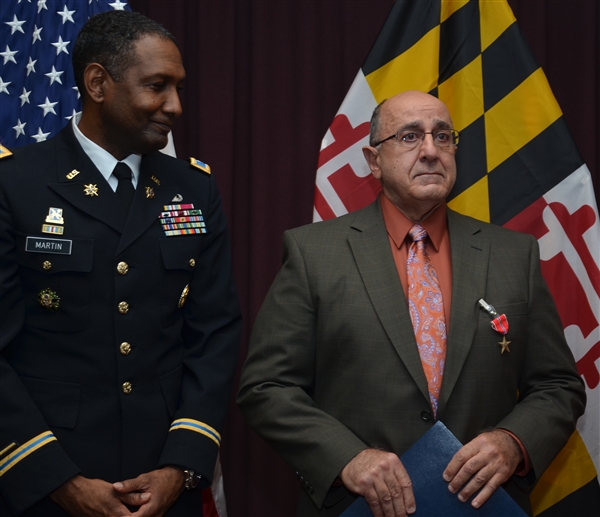 Defense Information School Commandant Army Col. Jeremy Martin, left, looks on after Army veteran and former Spc. 4 Charles Shyab was presented the Bronze Star medal for valor by U.S. Sen. Barbara A. Mikulski during a formal ceremony at DINFOS, Nov. 9, 2012. The ceremony was attended by roughly 250 family members, community leaders, DINFOS staff and students. U.S. Army photo by Spc. Joseph Joynt.
READ MORE about the Bronze Star


Click Here for a news video of the presentation
Refugees and “Boat People”
Refugees and “Boat People”
The immigration of thousands of people from Southeast Asia in the 1970s and 1980s impacted American-Vietnamese relations and gave rise to new communities of Vietnamese, Cambodian, Laotian, and Hmong Americans in the United States. Known as boat people for escaping Southeast Asia by sea, the exodus of hundreds of thousands of Southeast Asians (predominantly Vietnamese) generated a political and humanitarian firestorm for the international community, the United States, and Vietnam. Continue reading
Vietnamese Veterans
Vietnamese Veterans
For Vietnamese veterans on both sides of the conflict, the violence of war remained firmly with them for the rest of their lives. For the victorious communist troops, the end of the war meant a return home to participate in village life and the rebuilding of a united nation. Compared to South Vietnamese veterans, many northern veterans suffered long isolation from their families whom they had not seen in some cases since the mid-1960s. The communist government forbade the returning veterans to fully take part in village politics due to fears that ex-soldiers would take on increased power through their enhanced status as war heroes. Over the next two decades the veterans fared poorly and received paltry rations of rice, meat, and cigarettes in compensation for their war service. Even more so than for American veterans, Vietnamese veterans were largely forgotten by the government, and the service of women was utterly ignored. Only near the end of the twentieth century did the Vietnamese government fully honor the women who fought as front-line troops during the war. Continue reading
Hurricane Sandy
Received via email from our buddy Peter Gaworecki:
**********************************************************************
Friends,
What has happened in the Northeast makes Katrina look minor league in cost. The local talking heads are predicting $500 Billion. Fortunately, with the help of FEMA, supplies and equipment were in place before the storm hit.
People evacuated as instructed which saved many lives. Many precautions were taken by all localities. Sandy overwhelmed the area and exceeded the predictions by several feet. Though many are homeless and utilities are weeks away in many places, there is no Superdome situation here.
If you watched The Weather Channel before she hit, Jim Cantore showed on a light pole the expected high water mark at about 8 ft. up the pole. It went to 13 ft. That was Battery Park.
The lower quarter on Manhattan was under water. Staten Island, population mostly city workers fire and policemen was devastated. I think they need the most help.
There are several towns in NJ that were wiped out. The boardwalks and amusement parks are gone off the Jersey shore.
What is needed most immediately is blood, please donate.
Pete
Peter Gaworecki, DMOR
C/1/22 67-68

 Charlie Company Vietnam 1966-1972