
Posts
P-38
From Wikipedia, the free encyclopedia
Vietnam war-era P-38 can opener. U.S. one cent coin shown for size comparison.
The P-38, developed in 1942, is a small can opener issued in the canned field rations of the United States Armed Forces from World War II to the 1980s. Originally designed for and distributed in the K-ration, it was later included in the C-ration.
DESIGN
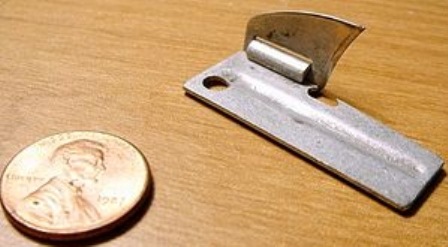 The P-38 is known as a “John Wayne” by the United States Marine Corps, either because of its toughness and dependability, or because of an unsubstantiated story that the actor had been shown in an as-yet-unidentified training film opening a can of K-Rations. The can opener is pocket-sized, approximately 1.5 inches (38 mm) long, and consists of a short metal blade that serves as a handle, with a small, hinged metal tooth that folds out to pierce the can lid. A notch just under the hinge point keeps the opener hooked around the rim of the can as the device is “walked” around to cut the lid out. A larger version called the P-51 is somewhat easier to operate. The handle portion can also double as a flat-blade screwdriver.
Official military designations for the P-38 include “US ARMY POCKET CAN OPENER” and “OPENER, CAN, HAND, FOLDING, TYPE I”. As with some other military terms, e.g., “jeep”, the origin of the term is not known with certainty; the P-38 opener coincidentally shares a designation with the Lockheed P-38 Lightning fighter plane, which could allude to its fast performance. However, the P-51 can opener, while larger and easier to use than the P-38 can opener, also has a fighter plane namesake in the North American P-51 Mustang, which is faster and smaller than the P-38 fighter. One rumored explanation for the origin of the name is that the P-38 is approximately 38 mm (1.5 in) long. This explanation also holds for the P-51, which measures approximately 51 mm (2.0 in) in length. United States Army sources, however, indicate that the origin of the name is rooted in the 38 punctures around the circumference of a C-ration can required for opening.
P-38s are no longer used for individual rations by the United States Armed Forces, as canned C-rations were replaced by MRE rations in the 1980s, packed in plastic pouches. The larger P-51s are, however, included with United States military “Tray Rations” (canned bulk meals). They are also still seen in disaster recovery efforts and have been handed out alongside canned food by rescue organizations, both in America and abroad in Afghanistan. The original U.S.-contract P-38 can openers were manufactured by J.W. Speaker Corporation (stamped “US Speaker”) and by Washburn Corporation (marked “US Androck”); they were later made by Mallin Hardware (now defunct) of Shelby, Ohio and were variously stamped “US Mallin Shelby O.” or “U.S. Shelby Co.”
ADVANTAGES
The P-38 is cheaper to manufacture than a standard can opener, and is smaller and lighter to carry. The device can be easily attached to a keychain or dog tag chain using the small punched hole.
USAGE
The P-38 is easily used. First, the cutting point is pivoted to its 95-degree position, from its stowed, folded position. Then, for a right-handed user, the P-38 is held in the right hand by the flat long section, with the cutting point pointing downward and away from the user, while also hooking the edge of the can through the circular notch located on the flat long section next to the cutting edge. The can is held in the left hand, and the right hand is rotated slightly clockwise, causing the can lid to be punctured. The can is then rotated counter clockwise in the left hand, while the right hand rotates alternatively slightly counterclockwise and slightly clockwise, until the can has been rotated nearly 360 degrees and the lid is nearly free. The lid of the now opened can is lifted, most often with the P-38 cutting edge, and the P-38 is wiped clean, and the cutting point is rotated back to its stowed, folded position; then, the P-38 is returned to its stored location, whether that is dangling on a dog tag chain around one’s neck, or in one’s pocket if the P-38 is attached to a key ring. Left-handed users simply hold the P-38 in their left hand, with the cutting point aimed towards themselves, while holding the can to be opened in their right hand, while also reversing the sense of the cutting hand movements just described. By tradition, 38 cuts as just described were supposedly required to open a can of C-Rations.
TO OPEN CAN
Place opener on the can with rim of can inside the slot. Hold between thumb and forefinger and twist forward to puncture. Repeat motion until can is open.
SIMILAR DEVICES
Standard issue “FRED” can opener of the Australian Defence Force.
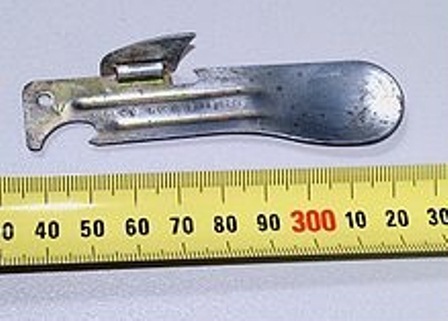 A similar device that incorporates a small spoon at one end and a bottle opener at the other is currently employed by the Australian Defence Force and New Zealand Army in its ration kits. The Field Ration Eating Device is known by the acronym “FRED”. It is also known widely in its derogative term, the “Fucking Ridiculous Eating Device”.
–Rumors have it that there is a secret P-38 society
Daily Retreat
Daily retreat on a beach in New Jersey…
Wannabees
Interesting Census Stats and “Been There” Wanabees
1,713,823 of those who served in Vietnam were still alive as of August, 1995 (census figures).
During that same Census count, the number of Americans falsely claiming to have served in-country was: 9,492,958.
As of the current Census taken during August, 2000, the surviving U.S. Vietnam Veteran population estimate is: 1,002,511. This is hard to believe, losing nearly 711,000 between ’95 and ’00. That’s 390 per day. During this Census count, the number of Americans falsely claiming to have served in-country is: 13,853,027. By this census, FOUR OUT OF FIVE WHO CLAIM TO BE VIETNAM VETS ARE NOT.
The Department of Defense Vietnam War Service Index officially provided by The War Library originally reported with errors that 2,709,918 U.S. military personnel as having served in-country. Corrections and confirmations to this errored index resulted in the addition of 358 U.S. military personnel confirmed to have served in Vietnam but not originally listed by the Department of Defense (All names are currently on file and accessible 24/7/365).

Agent Orange: Veteran Health Issues and Legal Battle
Questions regarding Agent Orange arose in the United States after an increasing number of returning Vietnam veterans and their families began to report a range of afflictions, including rashes and other skin irritations, miscarriages, psychological symptoms, Type-2 diabetes, birth defects in children and cancers such as Hodgkin’s disease, prostate cancer and leukemia.
In 1979, a class action lawsuit was filed on behalf of 2.4 million veterans who were exposed to Agent Orange during their service in Vietnam. Five years later, in an out-of-court-settlement, seven large chemical companies that manufactured the herbicide agreed to pay $180 million in compensation to the veterans or their next of kin. Various challenges to the settlement followed, including lawsuits filed by some 300 veterans, before the U.S. Supreme Court confirmed it in 1988. By that time, the settlement had risen to some $240 million including interest. In 1991, President George H.W. Bush signed into law the Agent Orange Act, which mandated that some diseases associated with defoliants (including non-Hodgkin’s lymphomas, soft tissue sarcomas and chloracne) be treated as the result of wartime service and helped codify the VA’s response to veterans with conditions related to their exposure to Agent Orange.
Effects of Agent Orange on Vietnam
In addition to the massive environmental impact of the U.S. defoliation program in Vietnam, that nation has reported that some 400,000 people were killed or maimed as a result of exposure to herbicides like Agent Orange. In addition, Vietnam claims half a million children have been born with serious birth defects, while as many 2 million people are suffering from cancer or other illness caused by Agent Orange.
Chickie Donohue and the Greatest Beer Run of All Time
At the height of the Vietnam War, one man snuck back into the war zone to find his 3 closest friends and buy them a beer. 47 years later, the group reunited to relive the greatest beer run of all time.
Thanks to JS for the link. Hooah
Gary Beikirch, Medal of Honor, Vietnam War
Special Forces medic Gary Beikirch treated wounded indigenous and U.S. soldiers under intense fire in the Kontum Province, South Vietnam, on April 1, 1970. He was presented with the Medal of Honor on October 15, 1973.
Thanks to Charlie for the link. Hooah
GOD BLESS OUR MEDICS – they were the true heroes.
 Charlie Company Vietnam 1966-1972