Light at the End of the Tunnel

By the end of 1967 an American Army of 485,000 soldiers and marines, backed up by an enormous logistical system, had deployed in country; and officials talked brightly that there was now “light at the end of the tunnel.”

President Johnson, National Security Adviser Walt Rostow, Secretary of State Rusk, JCS Chairman Wheeler, CINCPAC Adm. Ulysses S. Grant Sharp, Ambassador Bunker, and MACV commander General Westmoreland all appeared confident that American ground and air operations were so grinding down Communist forces in Vietnam that they would not be able to maintain anything more than a limited war of attrition. The pronounced gulf between their beliefs and reality deserves representative highlighting. Continue reading

Search and Destroy

The three most basic operations or missions were:

1. Search and destroy,

2. Clearing,

3. Security.

These terms and the concepts they described were new, and like most new names and ideas, they were understood by some and misunderstood by others. Best known and most misunderstood was search and destroy. Search and destroy operations began in 1964, before U.S. ground forces were committed. These operations were conducted to locate the North Vietnamese Army and Viet Cong main force units in and around their base areas and to attack them by fire and maneuver. Since enemy infiltration of the populated areas depended heavily on the availability of base areas near the population centers, destruction of close-in base areas received priority attention. Continue reading

Free-Fire Zone

A free-fire zone was an area that had been cleared of all civilians, with any remaining people assumed to be hostile forces. “Free-fire zone” is also one of those terms that if repeated often enough will make folks dive under the coffee table and hide their heads. Only in Vietnam was political clearance required prior to placing fire on the enemy, that is, clearance from ARVN officials was required for all but clearly defensive fire except into a “free-fire zone.” A free-fire zone, however, did not relieve the commander of his concurrent obligation to comply with the laws of war, operating authorities, and the rules of engagement. Continue reading

Tomb of the Unknowns IV

The Unknown of World War I

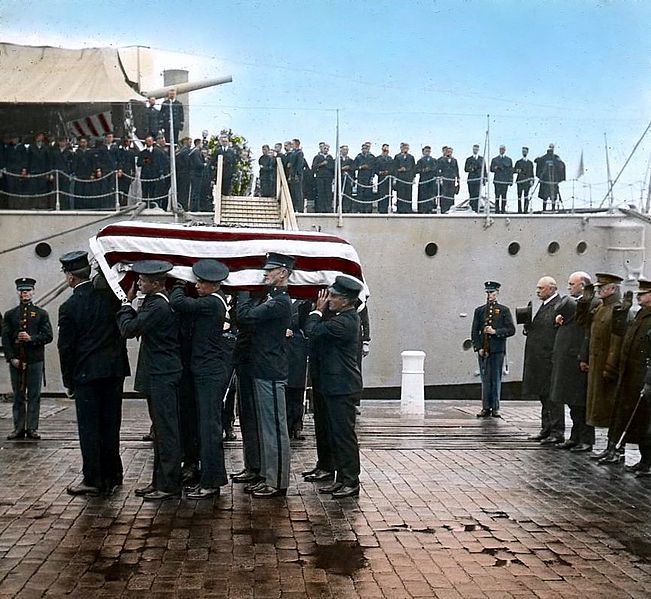
TU-WWIThe World War I Unknown arriving at the Washington Navy Yard, 1921 (colorized)

On Memorial Day, 1921, four unknown servicemen were exhumed from four World War I American cemeteries in France. U.S. Army Sgt. Edward F. Younger, who was wounded in combat, highly decorated for valor and received the Distinguished Service Cross in “The Great War” selected the Unknown of World War I from four identical caskets at the city hall in Châlons-en-Champagne, France, on October 24, 1921. Younger selected the World War I Unknown by placing a spray of white roses on one of the caskets. He chose the third casket from the left. The chosen Unknown was transported to the United States aboard the USS Olympia. Those remaining were interred in the Meuse Argonne Cemetery, France. Continue reading

Tomb of the Unknowns III

Tomb of 1921

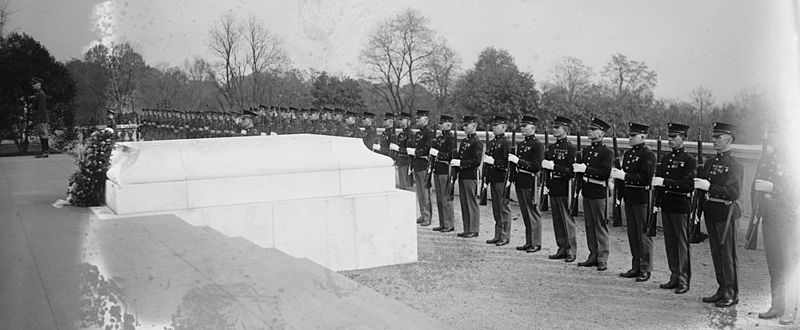
TU-1922Tomb as of November 11, 1922. The Tomb of 1931 would occupy this same location.

On March 4, 1921, the United States Congress approved the burial of an unidentified American serviceman from World War I in the plaza of the new Memorial Amphitheater. On November 11, 1921, the unknown soldier brought back from France was interred inside a three-level marble tomb. The marble came from a Yule Marble Quarry located near Marble, Colorado. The marble for the Lincoln Memorial and other famous monuments was quarried there. The bottom two levels are six marble sections each and the top at least nine blocks with a rectangular opening in the center of each level through which the unknown remains were placed through the tomb and into the ground below. A stone other than marble covers the rectangular opening. Continue reading

Tomb of the Unknowns II

Changing of the Guard

TU-TombGuardChangeChanging of the Guard at the Tomb of the Unknowns. Assistant Relief Commander at left, Guard passing orders in center, and Guard receiving orders at right. The tomb is behind the Assistant Relief Commander.

During the day in summer months from April 1 to September 30, the guard is changed every half hour. During the winter months, from October 1 to March 31, the guard is changed every hour. After the cemetery closes to the public (7 p.m. to 8 a.m. April through September, and 5 p.m. to 8 a.m. October through March), the guard is changed every 2 hours. The ceremony can be witnessed by the public whenever Arlington National Cemetery is open. Continue reading

Tomb of the Unknowns I

The Tomb of the Unknowns is a monument dedicated to American service members who have died without their remains being identified. It is also known as the Tomb of the Unknown Soldier; it has never been officially named. It is located in Arlington National Cemetery in Virginia, United States of America. The World War I “Unknown” is a recipient of the Medal of Honor, the Victoria Cross, and several other foreign nations’ highest service awards. The U.S. Unknowns who were interred are also recipients of the Medal of Honor, presented by the U.S. presidents who presided over their funerals. Continue reading

Reckless

Reckless was a pack horse during the Korean war, and she carried recoil-less rifles, ammunition and supplies to Marines. Nothing too unusual about that, lots of animals got pressed into doing pack chores in many wars.

But this horse did something more… during the battle for a location called Outpost Vegas, this mare made 50 trips up and down the hill, on the way up she carried ammunition, and on the way down she carried wounded soldiers…

So what was so amazing?

Well she made every one of those trips through enemy fire and without anyone leading her.

Here’s her story and photos to prove where she was and what she did.

CLICK HERE