Opposition to the Vietnam War Part VII

African Americans

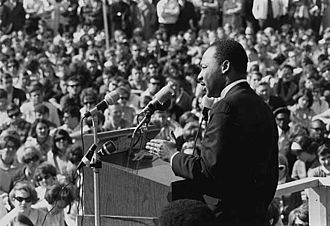
Martin Luther King, Jr. speaking to an anti-Vietnam War rally at the University of Minnesota, St. Paul on April 27, 1967
330px-Martin_Luther_King_Jr_St_Paul_Campus_U_MN

African Americans were often involved in the Civil Rights Movement and the antiwar movement. Martin Luther King, Jr. and James Bevel of the Southern Christian Leadership Conference (SCLC) were prominent opponents of the Vietnam War, and the Black Panther Party vehemently opposed U.S. involvement in Vietnam. In the beginning of the war, some African Americans did not want to join the war opposition movement because of loyalty to President Johnson for pushing Civil Rights legislation, but soon the escalating violence of the war and the perceived social injustice of the draft propelled involvement in antiwar groups. Black antiwar groups opposed the war for the same reason as white groups, but often protested in separate events and did not cooperate with the ideas of white antiwar leadership. They harshly criticized the draft because poor and minority men were usually most affected by conscription although the Washington Post in a 1986 in depth examination of who actually fought the Vietnam War entitled “The Myth of the Vietnam Vet” contradicted this assertion. According to the Post, “The man who fought in Vietnam is typically depicted as a draftee, unwilling and probably black. In fact, 73 percent of those who died were volunteers and 12.5 percent were black (out of an age group that comprised 13.5 percent of the male population).” African Americans involved in the antiwar movement often formed their own groups, such as Black Women Enraged, National Black Anti-War Anti-Draft Union, and National Black Draft Counselors. Within these groups, however, many African American women were seen as subordinate members by black male leaders. Many African American women viewed the war in Vietnam as racially motivated and sympathized strongly with Vietnamese women. Such concerns often propelled their participation in the antiwar movement and their creation of new opposition groups.

Opposition to the Vietnam War Part VI

Women

Women were a large part of the antiwar movement, even though they were sometimes relegated to second-class status within the organizations or faced sexism within opposition groups. Some leaders of anti-war groups viewed women as sex objects or secretaries, not actual thinkers who could contribute positively and tangibly to the group’s goals, or believed that women could not truly understand and join the antiwar movement because they were unaffected by the draft. Women involved in opposition groups disliked the romanticism of the violence of both the war and the antiwar movement that was common amongst male war protestors. Despite the inequalities, participation in various antiwar groups allowed women to gain experience with organizing protests and crafting effective antiwar rhetoric. These newfound skills combined with their dislike of sexism within the opposition movement caused many women to break away from the mainstream antiwar movement and create or join women’s antiwar groups, such as Another Mother for Peace, Women’s International League for Peace and Freedom (WILPF), and Women Strike for Peace (WSP), also known as Women For Peace. Female soldiers serving in Vietnam joined the movement to battle the war and sexism, racism, and the established military bureaucracy by writing articles for antiwar and antimilitary newspapers.

Mothers and older generations of women joined the opposition movement, as advocates for peace and people opposed to the effects of the war and the draft on the generation of young men. These women saw the draft as one of the most disliked parts of the war machine and sought to undermine the war itself through undermining the draft. Another Mother for Peace and WSP often held free draft counseling centers to give young men legal and illegal methods to oppose the draft. Members of Women For Peace showed up at the White House every Sunday for 8 years from 11 to 1 for a peace vigil. Such female antiwar groups often relied on maternalism, the image of women as peaceful caretakers of the world, to express and accomplish their goals. The government often saw middle-aged women involved in such organizations as the most dangerous members of the opposition movement because they were ordinary citizens who quickly and efficiently mobilized.

Many women in America sympathized with the Vietnamese civilians affected by the war and joined the opposition movement. They protested the use of napalm, a highly flammable jelly weapon created by Dow Chemical Company and used as a weapon during the war, by boycotting Saran Wrap, another product made by the company.

Faced with the sexism sometimes found in the antiwar movement, New Left, and Civil Rights Movement, some women created their own organizations to establish true equality of the sexes. Some of frustrations of younger women became apparent during the antiwar movement: they desired more radical change and decreased acceptance of societal gender roles than older women activists. Female activists’ disillusion with the antiwar movement led to the formation of the Women’s Liberation Movement to establish true equality for American women in all facets of life.

Opposition to the Vietnam War Part V

Arts

Many artists during the 1960s and 1970s opposed the war and used their creativity and careers to visibly oppose the war. Writers and poets opposed to involvement in the war included Allen Ginsberg, Denise Levertov, Robert Duncan, and Robert Bly. Their pieces often incorporated imagery based on the tragic events of the war as well as the disparity between life in Vietnam and life in the United States. Visual artists Ronald Haeberle, Peter Saul, and Nancy Spero, among others, used war equipment, like guns and helicopters, in their works while incorporating important political and war figures, portraying to the nation exactly who was responsible for the violence. Filmmakers such as Lenny Lipton, Jerry Abrams, Peter Gessner, and David Ringo created documentary-style movies featuring actual footage from the antiwar marches to raise awareness about the war and the diverse opposition movement. Playwrights like Frank O’Hara, Sam Shepard, Robert Lowell, Megan Terry, Grant Duay, and Kenneth Bernard used theater as a vehicle for portraying their thoughts about the Vietnam War, often satirizing the role of America in the world and juxtaposing the horrific effects of war with normal scenes of life. Regardless of medium, antiwar artists ranged from pacifists to violent radicals and caused Americans to think more critically about the war. Art as war opposition was quite popular in the early years of the war, but soon faded as political activism became the more common and most visible way of opposing the war.

Opposition to the Vietnam War Part IV

Antiwar movement

As the Vietnam War continued to escalate, public disenchantment grew and a variety of different groups were formed or became involved in the movement.

Students

U.S. Marshals dragging away a Vietnam War protester in Washington, D.C., 1967 Washington_D.C._Anti-Vietnam_Demonstration._U.S._Marshals_bodily_remove_one_of_the_protesters_during_the_outbreak_of..._-_NARA_-_530620.tif

There was a great deal of civic unrest on college campuses throughout the 1960s as students became increasingly involved in African-American civil rights, women’s liberation, and anti-Vietnam War movements. Doug McAdam explains the success of the mass mobilization of volunteers for Freedom Summer in terms of “Biographical Availability”, where individuals must have a certain degree of social, economic, and psychological freedom to be able to participate in large scale social movements. This explanation can also be applied to the Anti-War Movement because it occurred around the same time and the same biographical factors applied to the college-aged anti-war protesters. David Meyers (2007) also explains how the concept of personal efficacy affects mass movement mobilization. For example, consider that American wealth increased drastically after World War II. At this time, America was a superpower and enjoyed great affluence after thirty years of depression, war, and sacrifice. Benjamin T. Harrison argues that the post World War II affluence set the stage for the protest generation in the 1960s. His central thesis is that the World Wars and Great Depression spawned a ‘beat generation’ refusing to conform to mainstream American values which lead to the emergence of the Hippies and the counterculture. The Anti-war movement became part of a larger protest movement against the traditional American Values and attitudes. Meyers (2007) builds off this claim in his argument that the “relatively privileged enjoy the education and affirmation that afford them the belief that they might make a difference.” As a result of the present factors in terms of affluence, biographical availability and increasing political atmosphere across the county, political activity increased drastically on college campuses.

College enrollment reached 9 million by the end of the 1960s. Colleges and universities in America had more students than ever before, and these institutions often tried to restrict student behavior to maintain order on the campuses. To combat this, many college students became active in causes that promoted free speech, student input in the curriculum, and an end to archaic social restrictions. Students joined the antiwar movement because they did not want to fight in a foreign civil war that they believed did not concern them or because they were morally opposed to all war. Others disliked the war because it diverted funds and attention away from problems in the U.S. Intellectual growth and gaining a liberal perspective at college caused many students to become active in the antiwar movement. Another attractive feature of the opposition movement was the fact that it was a popular social event. As one student said, antiwar demonstrations were the places to “get laid, get high, and listen to some great rock.”

Most student antiwar organizations were locally or campus-based because they were easier to organize and participate in than national groups. Common antiwar demonstrations for college students featured attempts to sever ties between the war machine and universities through burning draft cards, protesting universities furnishing grades to draft boards, and protesting military and Dow Chemical job fairs on campus. From 1969 to 1970, student protestors attacked 197 ROTC buildings on college campuses. Protests grew after the Kent State shootings, radicalizing more and more students. Although the media often portrayed the student antiwar movement as aggressive and widespread, only 10% of the 2500 colleges in the United States had violent protests throughout the Vietnam War years. By the early 1970s, most student protest movements died down due to President Nixon’s de-escalation of the war, the economic downturn, and disillusionment with the powerlessness of the antiwar movement.

Opposition to the Vietnam War Part III

Polarization

If America’s soul becomes totally poisoned, part of the autopsy must read “Vietnam.”

— Martin Luther King, Jr., 1967

The U.S. became polarized over the war. Many supporters of U.S. involvement argued for what was known as the domino theory, a theory that believed if one country fell to communism, then the bordering countries would be sure to fall as well, much like falling dominoes. This theory was largely held due to the fall of eastern Europe to communism and the Soviet sphere of influence following World War II. However, military critics of the war pointed out that the Vietnam War was political and that the military mission lacked any clear idea of how to achieve its objectives. Civilian critics of the war argued that the government of South Vietnam lacked political legitimacy, or that support for the war was completely immoral.

The media also played a substantial role in the polarization of American opinion regarding the Vietnam War. For example, In 1965 a majority of the media attention focused on military tactics with very little discussion about the necessity for a full scale intervention in Southeast Asia.[6] After 1965, the media covered the dissent and domestic controversy that existed within the United States, but mostly excluded the actual view of dissidents and resisters.

The media established a sphere of public discourse surrounding the Hawk versus Dove debate. The Dove was a liberal and a critic of the war. Doves claimed that the war was well–intentioned but a disastrously wrong mistake in an otherwise benign foreign policy. It is important to note the Doves did not question the U.S. intentions in intervening in Vietnam, nor did they question the morality or legality of the U.S. intervention. Rather, they made pragmatic claims that the war was a mistake. Contrarily, the Hawks argued that the war was legitimate and winnable and a part of the benign U.S. foreign policy. The Hawks claimed that the one-sided criticism of the media contributed to the decline of public support for the war and ultimately helped the U.S. lose the war. Author William F. Buckley repeatedly wrote about his approval for the war and suggested that “The United States has been timid, if not cowardly, in refusing to seek ‘victory’ in Vietnam.” The hawks claimed that the liberal media was responsible for the growing popular disenchantment with the war and blamed the western media for losing the war in Southeast Asia.

Opposition to the Vietnam War Part II

Reasons for Opposition

The reasons behind American opposition to the Vietnam War fell into several main categories: opposition to the draft; moral, legal, and pragmatic arguments against U.S. intervention; and reaction to the media portrayal of the devastation in Southeast Asia.

330px-Vietnam_War_protesters._1967._Wichita,_Kans_-_NARA_-_283625

The draft, as a system of conscription which threatened lower class registrants and middle class registrants alike, drove much of the protest after 1965. Conscientious objectors did play an active role although their numbers were small. The prevailing sentiment that the draft was unfairly administered inflamed blue-collar American and African-American opposition to the military draft itself.

Opposition to the war arose during a time of unprecedented student activism which followed the free speech movement and the civil rights movement. The military draft mobilized the baby boomers who were most at risk, but grew to include a varied cross-section of Americans. The growing opposition to the Vietnam War was partly attributed to greater access to uncensored information presented by the extensive television coverage on the ground in Vietnam.

Beyond opposition to the draft, anti-war protesters also made moral arguments against the United States’ involvement in Vietnam. This moral imperative argument against the war was especially popular among American college students, who were more likely than the general public to accuse the United States of having imperialistic goals in Vietnam and to criticize the war as “immoral.” Civilian deaths, which were either downplayed or omitted entirely by the Western media, became a subject of protest when photographic evidence of casualties emerged. An infamous photo of General Nguyễn Ngọc Loan holding a pistol to the head of an alleged terrorist during the Tet Offensive also provoked public outcry.

Another element of the American opposition to the war was the perception that U.S intervention in Vietnam, which had been argued as acceptable due to the Domino Theory and the threat of Communism, was not legally justifiable. Some Americans believed that the Communist threat was used as a scapegoat to hide imperialistic intentions, while others argued that the American intervention in South Vietnam interfered with the “self-determination” of the country. They felt that the war in Vietnam was a civil war that ought to have determined the fate of the country and, therefore, America was not right to intervene.

Media coverage of the war in Vietnam also shook the faith of citizens at home as new media technologies, like television, brought images of wartime conflict to the kitchen table. Newsmen like NBC’s Frank McGee stated that the war was all but lost as a “conclusion to be drawn inescapably from the facts.” For the first time in American history the media was privileged to dispense battlefield footage to public. Graphic footage of casualties on the nightly news eliminated any myth of the glory of war. With no clear sign of victory in Vietnam, the media images of American military casualties helped to stimulate the opposition of the war in Americans. In their book Manufacturing Consent, Noam Chomsky and Edward Herman challenge this traditional view of how the media influenced the war, proposing instead that the media censored the more brutal images of the fighting and the death of millions of innocent people.

On April 4, 1967 in New York City, Civil rights leader Martin Luther King detailed his rationales for opposition to U.S. involvement in the Vietnam War. King claimed that America had rejected Ho Chi Minh’s revolutionary government which he said was seeking Vietnamese self-determination. Ho’s government, said King, “was a government that had been established not by China (for whom the Vietnamese have no great love) but by clearly indigenous forces that included some Communists. For the peasants this new government meant real land reform, one of the most important needs in their lives.”

Opposition to the Vietnam War Part I

Opposition to the Vietnam War

The movement against the involvement of the United States in the Vietnam War began in the U.S. with demonstrations in 1964 and grew in strength in later years. The U.S. became polarized between those who advocated continued involvement in Vietnam and those who wanted peace.

Many in the peace movement were students, mothers, or anti-establishment hippies. Opposition grew with participation by the African-American civil rights, women’s liberation, and Chicano movements, and sectors of organized labor. Additional involvement came from many other groups, including educators, clergy, academics, journalists, lawyers, physicians (such as Benjamin Spock), Civil Rights Movement leaders and military veterans. Opposition consisted mainly of peaceful, nonviolent events; few events were deliberately provocative and violent. In some cases, police used violent tactics against demonstrators. By 1967, according to Gallup Polls, an increasing majority of Americans considered US military involvement in Vietnam to be a mistake, echoed decades later by the then head of American war planning, former U.S. Secretary of Defense Robert McNamara.