Targeting The Ho Chi Minh Trail – The Air Power Debate

At the earliest stages of major US involvement in Vietnam, military strategists recognized that North Vietnam’s ability to use the Ho Chi Minh Trail to re-supply their forces in the south had to be curtailed. In reviewing their options, their thoughts turned to air power as a means of disrupting the North Vietnamese communications network and forcing Hanoi to enter into serious negotiations for peace with minimal risk to American personnel. Another objective, advocated by officials such as McGeorge Bundy, Johnson’s national security advisor, was to “bolster South Vietnamese morale and reaffirm the credibility of the American commitment to resist revolutionary activity in the Third World.”

Although the aims of the bombing campaign were widely shared, there was much debate over the timing, method, and intensity of the bombing. Robert A. Pape, a military historian who has written extensively on the theory and practice of airpower, identified three competing strategies that were current in 1966: the Civilian strategy, the Air Force strategy, and the Army strategy. Continue reading

4th Infantry Afghan

Targeting The Ho Chi Minh Trail

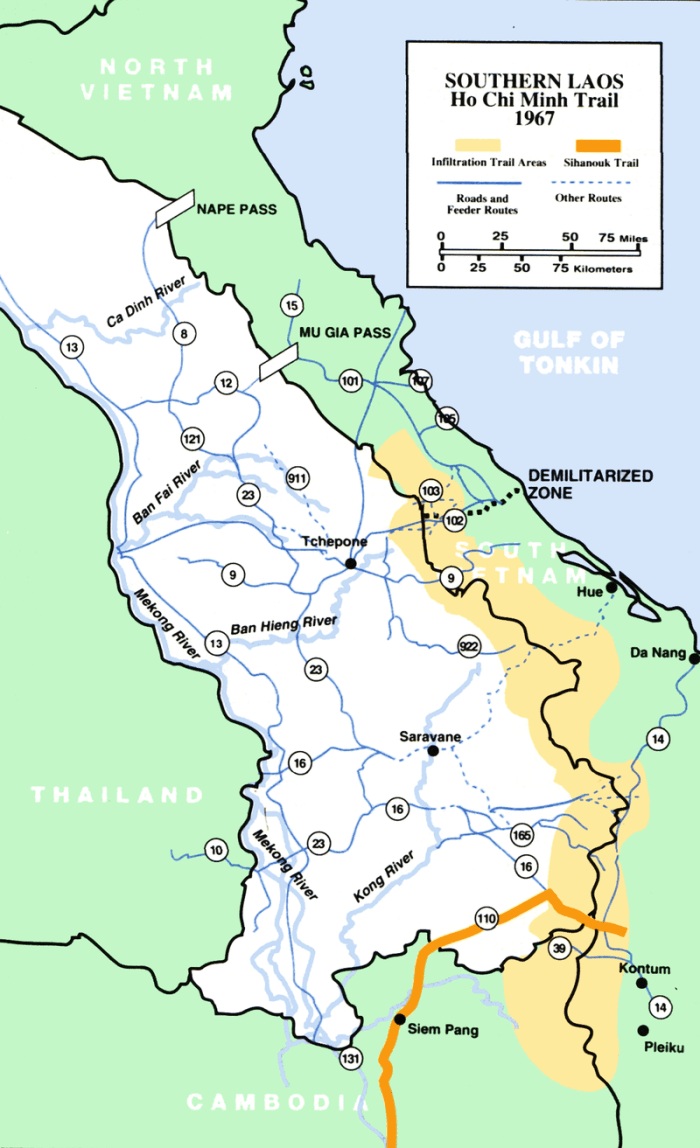
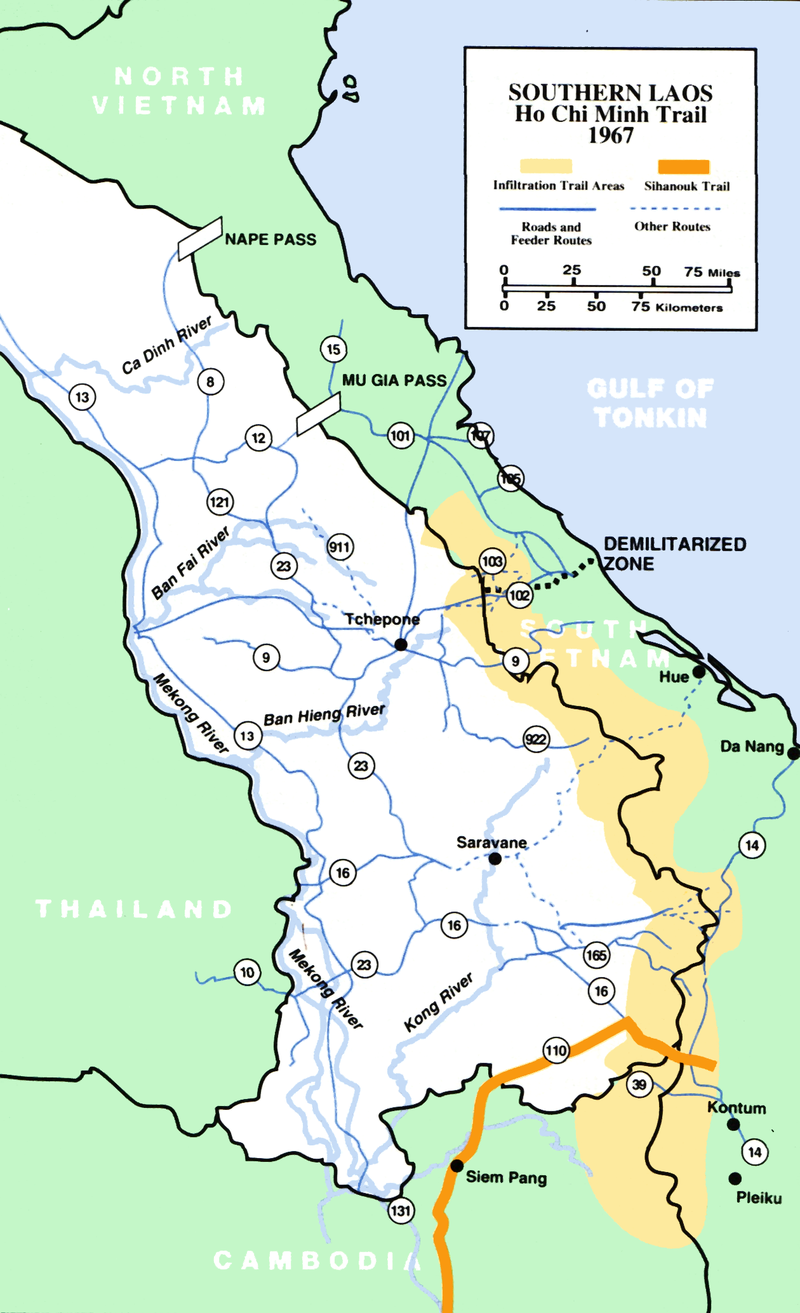
800px-hocmtThe Ho Chi Minh trail, known within Vietnam as the “Truong Son Strategic Supply Route,” was an elaborate system of mountain and jungle trails linking North Vietnam to its allies in the South Vietnam, Cambodia, and Laos. During the Vietnam War, it served as the primary artery for moving troops, vehicles, and supplies. Comprising more than twelve thousand miles of roads and paths through some of the world’s harshest geography, it was a vital gateway linking a divided nation.

The road network extended from Mu Gia Pass in the north, southward along the heavily forested western slopes of Laos, before entering South Vietnam at the northwestern end of the Plei Trap Valley — the “Valley of Tears” — and points south. It was kept in good condition by 300,000 full-time workers and almost as many part-time farmers, many of whose bodies fill the 72 Vietnamese military cemeteries that testify to the trail’s devastating human toll.

The trail’s history as a line of communication dates back to World War II, when Viet Minh bands trekked the same paths. During the war against the United States, the existing footpaths developed into a highly organized infiltration route for men and supplies. Although the North Vietnamese made limited use of waterways and pipelines, this labyrinth of roads and trails remained throughout the war the heart of their logistic system. As military historian John Prados has pointed out, whereas supplies, ammunition, and weapons could be sent South by boat, “only overland was it possible for men and women to head South and join in combat.”

Despite Hanoi’s attempts to keep the details of its overland infiltration network a secret, by 1960, US knowledge of the route was widespread enough that it became a subject of intelligence predictions. An August 23, 1960 CIA report noted increases in support from the North of the Southern insurgency, citing heightened movement of senior cadres and military supplies such as communications equipment heading south through Laos and Cambodia. Before the year’s end, American military planners were advising the Diem government that it had to gain “firmer control of its frontiers,” to prevent further infiltration by the Viet Cong into South Vietnam.

A September 1966 intelligence study estimated that during the October-November 1965 period, the Ho Chi Minh trail had been disgorging 4500 enemy troops per month and 300 tons of supplies per day. Roadwatch reports and photo reconnaissance verified increased North Vietnamese buildup along the lines of communication from the North into Laos and South Vietnam, revealing new unnumbered roads under construction in the Laotian Panhandle, heading southward.
Dead American Soldiers in Vietnam

Describing his buddy Chip, Tim O’Brien wrote: “he wrote letters to my sister. I wrote letters to his sister…In the bush…nothing kept us part. “Black and White” we were called. In May of 1969, Chip was blown high into a hedge of bamboo. Many pieces. I loved the guy, he loved me. I’m alive. He’s dead. An old story, I guess.”

It was not unusual for half the men in a company to get killed or wounded. One soldier told the Washington Post, “A few months before leaving Vietnam I spent four hours of my life 50 feet from a North Vietnamese machine-gun emplacement…One fellow exposed himself to enemy gunners and drew their fire…Then came his screams…We knew we were watching the man who had given his life for us die.” Continue reading

Resuming the Mission After the Swift Boat Ambush

LTJG Peter N. Upton wrote: “First light of 13 April manifested typical magnificence; lacking, however, were contemplative spirits necessary for the breathing in of such grandeur. Following the sumptuousness of mawkish tomato juice and canned scrambled eggs, orders were barked and the perimeter troops reembarked in order to proceed with the days schedule of sweeps. The buzzing activity provided a well-needed elixir, forcing wretched visions of the previous day’s ambush into realms of temporary obscurity. Towards nightfall the sweeps terminated and the Marines formed protective enclaves for the night’s rest. The swiftboats, released from support duty, then formed the classic file and headed to sea and safety, retracing the path of the tragic twelfth.

“Short minutes after getting underway the boats passed the still-life remains of the 43, an aesthetic aberration suspended on the north bank of the Duong Keo, simply out of joint with her surroundings. Looking at her bow, bending towards the azure heavens in a searching gesture, one could almost feel motion, a groping for the malignancy which was the cause of her agonizing death. The uninitiated might further try to recreate the essence of the once pulsating holocaust which presently stood calmly before them. The vibrant sensations of that enormity-the anguish, the torments, the frustrations, and the ecstasy-however, will forever remain an esoteric fact, privy to the surviving fifteen: no effort of meditation could possibly reveal those secrets.

Rescue After a Swift Boat Ambush

LTJG Peter N. Upton wrote: Thoughts gravitated toward rescue: where in almighty hell were the other boats? 43’s radio was destroyed beyond repair and the backup PRC-25 unit set up by LT Lomas and the SEALORDS staff officer lacked the transmission power to break into the net already froth with urgent traffic. PCF 38, seventh boat in the file, was just heading out of 43’s sight when she realized her trailing sister was missing. Brazenly, she attempted to implement rescue by reentering the ambush site. Thirty-eight’s bravery was thwarted by a rocket round which slammed into her pilot house, severely wounding the OIC and rendering her steering useless. The coxswain’s skillful manipulation of the twin screw throttles enabled the boat to limp out of the kill zone without suffering further damage. [Source: By LTJG Peter N. Upton, UDT-13, article supplied by Steven L. Waterman, mwweb.com/ndc/SwiftBoats]

“Upon reaching the medevac area, 38 passed the word of distress, thereby galvanizing the command boat, PCF 31, and a cohort, PCF 5, into swift action. Both boats entered the kill zone with guns roaring and arrived intact at the scene of battle. Thirty-one maneuvered into a position adjacent to the wreckage while 5 poured out covering fire. Long prayed-for extraction became a euphoric reality as dead and wounded persons were passed up, and finally, the perimeter was withdrawn, exhausted and unbelieving. The evacuation completed, 31 and 5 raced to the medevac perimeter where the dazed men of 43 joined the somber procession, ferrying the wounded to the dustoff helicopters,vainly trying to collect and convey their thoughts of the past hour. l he air was heavy with a pungent haze of disbelief.

“Meanwhile, only twenty minutes after her crew and UDT had been evacuated, 43’s fate was sealed as over a thousand pounds of high explosives and mortar rounds concocted an eruption of cataclysmic intensity, hurling a spuming vortex of flame, smoke, and twisting metal over five hundred feet into the air-her twin diesels could not be halted during the fight, had overheated and ignited fuel, thus starting the irrevocable chain which ended in her ultimate destruction. Wisely, the boats refused to risk a night transit and bivouacked in the river, tethering to mangrove stumps within the reinforced defense perimeter. Few of the 43 boat’s survivors could muster the strength to close their eyes; frozen to the decks of their new homes, they gazed into the starry firmament, wondering, reckoning.

Fighting Back Against a Swift Boat Ambush

LTJG Peter N. Upton wrote: “The bewildering, awesome reality of the situation was beclouded by momentary shock. The enemy, probably in a similar state of amazement, did not organize directly and afforded the 43’s survivors invaluable minutes in which to orient themselves. LT Lomas scurried into the pilot house and aided the wounded there. Sandlin’s pain was eased by a quick shot of morphine and a battle dressing. The sporadic shrapnel wounds of a minor nature were of no immediate concern. Survival, and survival only, was paramount, and to live, the survivors knew they had to fight. To this end, a hasty defense perimeter was formed. Campbell, with Piper and Broderick on the fantail, maintained constant M-79 grenade fire into the north bank. Luckily, the 43 boat canted toward the river and provided some natural cover for them. Crew members, discarding the .50 caliber weapons as useless, grabbed M-16 rifles and set up firing positions covering the south bank, thereby providing the stricken unit with a 360 degree perimeter. [Source: By LTJG Peter N. Upton, UDT-13, article supplied by Steven L. Waterman, mwweb.com/ndc/SwiftBoats]

“Simultaneous with these actions, Ruiz and Lowry found the detachment’s M-60 machine gun, and, using the 43’s hull for cover, slid past the bow in order to set up a firing position in a natural emplacement ten meters away. Sandlin, ready to go, was given a rifle and carried to this frontal position thereby supplying additional firepower. Concussion grenades were also used to supplement these basic weapons in the forty minute effort to ward off any attempts of an enemy assault. The foliage proved indeed provident, absorbing much of the enemy fire while precluding his use of rockets and heavy rounds altogether. Though continuous, the resulting incoming fire was relatively ineffective. Only Ruiz was seriously wounded in the ground action as a Chinese hand grenade exploded next to his M-60 firing position. Heroic acts became well-nigh routine as 43 was transformed into a blazing bunker: some fired while Hinson passed ammunition and loaded M-16 magazines; weapons jammed and were replaced; hand grenades were exchanged with the enemy but twenty meters away, a diabolical chess game, one Viet Cong spider hole checkmated by Lowry’s accurate throw. As a result of this aggressive perimeter action, the necessary volume of fire was sustained and the enemy never risked a frontal onslaught.

Swift Boat Ambush

Between the hours of 1800-1900, 12 April 1969, at a well-camouflaged sector along the narrow Duong Keo, southernmost in South Vietnam’s vast system of navigable waterways, U.S. Navy PCF’s (“swiftboats”) then supporting Vietnamese Marine river operations under the aegis of SEALORDS incurred their most devastating and demoralizing setback to date. A well-planned and perfectly executed Viet Cong heavy weapons ambush inflicted heavy material damage to every swiftboat unit involved in the action and accounted for thirty-nine wounded in action, many seriously and requiring immediate medical evacuation. Vietnamese Marine casualties were of equal severity. One of the eight boats involved, PCF 43, was totally destroyed during the encounter. Its mangled, blackened carcass still rests on the ambush site. Her seventeen-member crew included ten members of an underwater demolition team, two were killed: Only three of the remaining fifteen escaped unscathed.[Source: By LTJG Peter N. Upton, UDT-13, article supplied by Steven L. Waterman, mwweb.com/ndc/SwiftBoats]

LTJG Peter N. Upton wrote: “Vietnamese mornings are singularly beautiful… However, this morning elegance passed quickly, when word was passed to UDT promulgating the modus operandi and logistics requirements for the upcoming three-day SEALORDS operation. It was about 1630 hours when UDT personnel scampered down the sagging cargo net, consummating the already bulking load. Rendezvous with the PCF units involved in the mission took place approximately one hour later, one thousand meters outside the gaping mouth of the Duong Keo, the watery path which would lead to the day’s assigned sweep area. Forty-three informed the command boat of her special cargo, then took her assigned station as the rear element of a stately file of eight units. Flak gear was donned and battle stations manned on the fantail as the boats proceeded to enter the foreboding jaws of this river, infamous for its demonstrated hostility to allied units who dared venture into her inner reaches.  Continue reading