***********************************************************************
CLICK HERE to read the full article – then use the arrows to go to page 34, OR, click in the box and then click on page 34.
***********************************************************************
SOURCE: VFWMagazine.org
An article in the 4th Infantry Division “Ivy Leaf” states the following: Continue reading
He has done this for the past four years and each year is better than the previous. This year was spectacular. It was held at VFW Post 76 in San Antonio Texas. The VFW provided us with a lunch, posting of the colors, singing of the national anthem prior to our ceremony.
This year we lit candles for 55 casualties of Charlie Company between 1966 through 1970. Special candles were lit for Ann Konermann, and our deceased brothers who made it home from Vietnam.
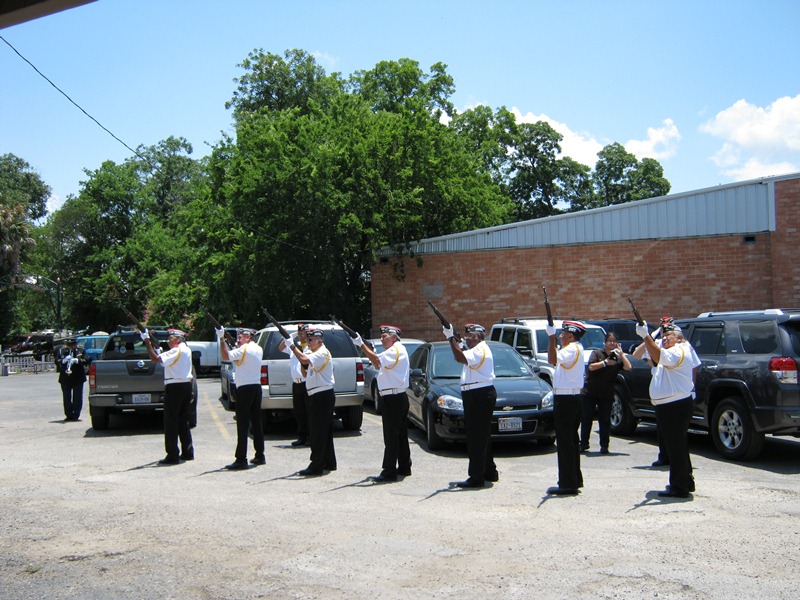
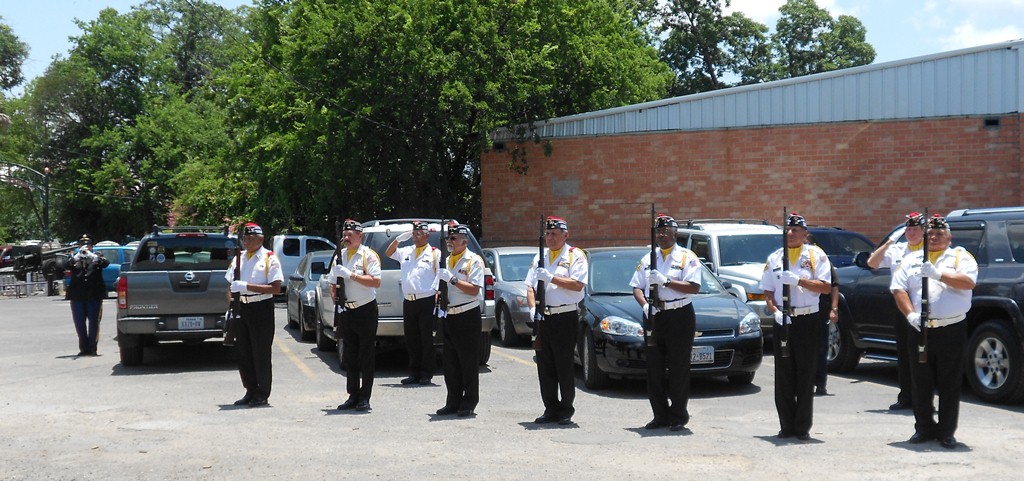
After the ceremony, the Post 76 Honor Guard gave a 21 gun salute to honor our brothers.
Then there was the playing of Echo Taps by the “Taps For Vets”, a not for profit organization.
The following email was recently received:
Dear Bud Roach,
“Taps For Vets” organization and myself would like to thank you for your generous donation of $150.00 to our organization. It is because of people like you that keeps us going and moving in the right direction. Since we are not for profit, we have to buy our own uniforms, shirts, gloves, shoes and any other necessary items for us to continue doing our services. We will use this money to provide us with necessary equipment for our organization. Again, we thank you from the bottom of our hearts. I hope that everything was to your satisfaction.
Thanks.
Taps For Vets/Bugler Services; Sgt. Ray Gutierrez- U.S. Army Veteran/ Bugler; “Veterans Honoring Veterans”
.
Short: a term used by everyone in Vietnam to tell all who would listen that his tour was almost over
Short-timer: soldier nearing the end of his tour in Vietnam
Short-timer’s stick: when a soldier had approximately two months remaining on his tour in Vietnam, he might take a long stick and notch it for each of his remaining days in-country. As each day passed he would cut the stick off another notch until on his rotation day he was left with only a small stub.
“I am so short I don’t have time for a long conversation.”
“I am so short, I can play handball against the curb.”
“I am so short I left yesterday.”


“I’d rather go down the river with seven studs than with a hundred shitheads”
– Colonel Charlie Beckwith
“We ain’t making no goddamn cornflakes here.”
-Col. Charlie Beckwith, founder of Delta Force
“Tanks are easily identified, easily engaged, much-feared targets which attract all the fire on the battlefield. When all is said and done, a tank is a small steel box crammed with inflammable or explosive substances which is easily converted into a mobile crematorium for its highly skilled crew.”
– Brigadier Shelford Bidwell
“War is God’s way of teaching Americans geography.”
– Ambrose Bierce
“I do not like this word “bomb.” It is not a bomb. It is a device that is exploding.”
French ambassador to New Zealand Jacques le Blanc, regarding press coverage of France’s nuclear weapons tests in the Pacific
“Give a man fire, and he’ll be warm for a day, light a man on fire, and he’ll be warm the rest of his life”
-Staff Sgt. Timothy A. Breen
“Gentlemen, we are being killed on the beaches. Lets go inland and be killed.”
– General Norman Cota: Omaha Beach, 1944
“We are outnumbered, there is only one thing to do. We must attack!”
– Admiral Andrew Cunningham, 11 November 1940. Before attacking the Italian fleet at Taranto
“Army: A body of men assembled to rectify the mistakes of the diplomats.”
– Josephus Daniels
“Onward we stagger, and if the tanks come, may God help the tanks.”
– Col. William O. Darby, U.S. Rangers
“When you men get home and face an anti-war protester, look him in the eyes and shake his hand. Then, wink at his girlfriend, because she knows she’s dating a pussy.”
– Attributed to General Tommy Franks
“War is hell, but actual combat is a motherfucker.”
– Colonel Dave Hackworth’s response to a reporter’s attempt to interview him about a battle
“I never trust a fighting man who doesn’t smoke or drink.”
– Admiral William Halsey
“I was provided with additional input that was radically different from the truth. I assisted in furthering that version.”
Colonel Oliver North, from his Iran-Contra testimony
“Paper-work will ruin any military force”
– Lieutenant-General Lewis B. “Chesty” Puller
“Just drive down that road, until you get blown up”
– General George Patton, about reconnaissance troops
“We should declare war on North Vietnam. . . .We could pave the whole country and put parking strips on it, and still be home by Christmas.”
– Ronald Reagan, 1965
“When I joined the military it was illegal to be homosexual, then it became optional, and now it’s legal. I’m getting out before Obama makes it mandatory.
– Gy. Sgt. Harry Berres, USMC
In August 1950, the CIA secretly purchased the assets of Civil Air Transport (CAT), an airline that had been started in China in 1946 by Gen. Claire Lee Chennault (of Flying Tigers fame) and Whiting Willauer.
In 1951, the parent company of Air America’s forerunner, Civil Air Transport (CAT), was reorganized. The owner, Chennault, was approached by the CIA, who bought out the company through a holding company, the American Airdale Corporation. Under this agreement, CAT was allowed to keep its initials and the company was reorganized as Civil Air Transport, Inc.
On 7 October 1957, American Airdale was reorganized to add another layer of obfuscation to its ownership. The new Pacific Corporation became a holding company for Air Asia Company (Air Asia (Taiwan)), Ltd; Air America, Inc; Civil Air Transport, Inc; Southern Air Transport; Intermountain Aviation; Bird and Sons (known as BirdAir); and Robinson Brothers. CAT attempted to change its name to Air America at the same time, but objections from Air France and American Airlines delayed the name change for two years.
Air America’s slogan was “Anything, Anywhere, Anytime, Professionally”. Air America aircraft, including the de Havilland Canada DHC-4 Caribou and Fairchild C-123 Provider, flew many types of cargo to countries such as the Republic of Vietnam, the Kingdom of Laos, and Cambodia. It operated from bases in those countries and also from bases in Thailand and as far afield as Taiwan and Japan. It also on occasion flew top-secret missions into Burma and the People’s Republic of China.
Air America’s headquarters moved several times during its existence, 808 17th St. NW, (1964), 801 World Center Bldg, (late 1964), 815 Connecticut Ave NW, (July 1968), and 1725 K Street NW, (1972), all in Washington, DC. Marana, Arizona was the principal continental United States maintenance base for Air America of which was located at Pinal Airpark.
From 1959 to 1962 the airline provided direct and indirect support to CIA Operations “Ambidextrous”, “Hotfoot”, and “White Star”, which trained the regular Royal Laotian armed forces. After 1962 a similar operation known as Project 404 fielded numerous U.S. Army attachés (ARMA) and air attachés (AIRA) to the U.S. embassy in Vientiane.
From 1962 to 1975, Air America inserted and extracted U.S. personnel, provided logistical support to the Royal Lao Army, Hmong army under command of Royal Lao Army Major General Vang Pao, and combatant Thai “volunteer” forces, transported refugees, and flew photo reconnaissance missions that provided valuable intelligence on NLF activities. Its civilian-marked craft were frequently used, under the control of the Seventh/Thirteenth Air Force to launch search and rescue missions for U.S. pilots downed throughout Southeast Asia. Air America pilots were the only known private U.S. corporate employees to operate non-Federal Aviation Administration-certified military aircraft in a combat role, although many of them were actually military personnel who had been transferred to the airline.
By the summer of 1970, the airline had some two dozen twin-engine transport aircraft, another two dozen short-take off-and-landing aircraft, and 30 helicopters dedicated to operations in Burma, Cambodia, Thailand, and Laos. There were more than 300 pilots, copilots, flight mechanics, and airfreight specialists based in Laos and Thailand. During 1970, Air America delivered 46 million pounds (21,000 metric tons) of food in Laos. Helicopter flight time reached more than 4,000 hours a month in the same year.
Air America flew civilians, diplomats, spies, refugees, commandos, sabotage teams, doctors, war casualties, drug enforcement officers, drugs, and even visiting VIPs like Richard Nixon all over Southeast Asia. Its non-human passengers were even more bizarre on occasion; part of the CIA’s support operations in Laos, for instance, involved logistical support for local tribes fighting the North Vietnamese forces and the Pathet Lao, their local opponents. Forced draft urbanization policies, such as the widespread application of Agent Orange to Vietnamese farmland created a disruption in local food production, so thousands of tons of food had to be flown in, including live chickens, pigs, water buffalo and cattle. On top of the food drops (known as ‘rice drops’) came the logistical demands for the war itself, and Air America pilots flew thousands of flights transporting and air-dropping ammunition and weapons (referred to as “hard rice”) to friendly forces.
When the North Vietnamese Army overran South Vietnam in 1975, Air America helicopters participated in Operation Frequent Wind evacuating both US civilians and South Vietnamese people associated with the regime from Saigon. The iconic photograph depicting the final evacuation from the “U.S. Embassy” by Dutch photographer Hubert van Es was actually an Air America helicopter taking people off of an apartment at 22 Gia Long Street building used by USAID and CIA employees.
Air America allegedly transported opium and heroin on behalf of Hmong leader Vang Pao. This allegation has been supported by former Laos CIA paramilitary Anthony Poshepny (aka Tony Poe), former Air America pilots, and other people involved in the war.
University of Georgia historian William M. Leary, writing on behalf of Air America itself, however claims that this was done without the airline employees’ direct knowledge (except for those employees that said they did know about it) and that the airline itself did not trade in drugs. Curtis Peebles denies the allegation, citing Leary’s study as evidence.
After pulling out of South Vietnam in 1975, there was an attempt to keep a company presence in Thailand; after this fell through, Air America officially disbanded on June 30, 1976, and was later purchased by Evergreen International Airlines, which continues to provide support for U.S. covert operations.
During its existence Air America operated a diverse fleet of aircraft, the majority of which were STOL capable. There was “fluidity” of aircraft between some companies like Air America, BOA, CASI and the USAF. It was not uncommon for USAF and US Army aviation units to loan aircraft to Air America for specific missions. Air America tended to register its aircraft in Taiwan, operating in Laos without the B- nationality prefix. Ex US military aircraft were often used with the “last three” digits of the military serial as a civil marking, sometimes with a B- prefix. The first two transports of Air America arrived in Vientiane, Laos on 23 August 1959. The Air America operations at Udorn, Thailand were closed down on 30 June 1974. Air America’s operating authority was cancelled by the CAB on 31 January 1974.


Source: Wikipedia
Air America is a 1990 American action comedy film directed by Roger Spottiswoode, starring Mel Gibson and Robert Downey Jr. as Air America pilots, during the Vietnam War, flying missions in Laos. The protagonists discover their planes are used by other government agents to smuggle heroin; and then, they must avoid being made patsies in a frame-up.
The plot is adapted from Christopher Robbins’ 1979 non-fiction book, chronicling the CIA financed airline during the Vietnam War to transport weapons and supplies within Laos and other areas of Indochina subsequent to the North Vietnamese invasion of Laos. The publicity for the film—advertised as a light-hearted buddy movie—implied a tone that differs greatly with the tone of the actual film, which includes such serious themes as an anti-war political spin, focus on the opium trade, and a negative portrayal of Royal Laotian General Vang Pao (played by actor Burt Kwouk as “General Lu Soong”).
.
CLICK – -› Who We Are
During the Vietnam War, women served on active duty doing a variety of jobs. Early in 1963, the Army Nurse Corps (ANC) launched Operation Nightingale, an intensive effort to recruit nurses to serve in Vietnam. Most nurses who volunteered to serve in Vietnam came from predominantly working or middle class families with histories of military service. The majority of these women were white Catholics and Protestants. Because the need for medical aid was great, many nurses underwent a concentrated four-month training program before being deployed to Vietnam in the ANC. Due to the shortage of staff, nurses usually worked twelve-hour shifts, six days per week and often suffered from exhaustion. First Lieutenant Sharon Lane was the only female military nurse to be killed by enemy gunfire during the war on June 8, 1969.
At the start of the Vietnam War, it was commonly thought that American women had no place in the military. Their traditional place had been in the domestic sphere, but with the war came opportunity for the expansion of gender roles. In Vietnam, women held a variety of jobs which included operating complex data processing equipment and serving as stenographers. Although a small number of women were assigned to combat zones, they were never allowed directly in the field of battle. The women who served in the military were solely volunteers. They faced a plethora of challenges, one of which was the relatively small number of female soldiers. Living in a male-dominated environment created tensions between the sexes. While this high male to female ratio was often uncomfortable for women, many men reported that having women in the field with them boosted their morale. Although this was not the women’s purpose, it was one positive result of their service. By 1973, approximately 7,500 women had served in Vietnam in the Southeast Asian theater. In that same year, the military lifted the prohibition on women entering the armed forces.
American women serving in Vietnam were subject to societal stereotypes. Many Americans either considered female in Vietnam mannish for living under the army discipline, or judged them to be women of questionable moral character who enlisted for the sole purpose of seducing men. To address this problem, the ANC released advertisements portraying women in the ANC as “proper, professional and well protected.” This effort to highlight the positive aspects of a nursing career reflected the ideas of second-wave feminism that occurred during the 1960s-1970s in the United States. Although female military nurses lived in a heavily male environment, very few cases of sexual harassment were ever reported. In 2008, by contrast, approximately one-third of women in the military felt that they had been sexually harassed compared with one-third of men.
Though relatively little official data exists about female Vietnam War veterans, the Vietnam Women’s Memorial Foundation estimates that approximately 11,000 military women were stationed in Vietnam during the conflict. Nearly all of them were volunteers, and 90 percent served as military nurses, though women also worked as physicians, air traffic controllers, intelligence officers, clerks and other positions in the U.S. Women’s Army Corps, U.S. Navy, Air Force and Marines and the Army Medical Specialist Corps. In addition to women in the armed forces, an unknown number of civilian women served in Vietnam on behalf of the Red Cross, United Service Organizations (USO), Catholic Relief Services and other humanitarian organizations, or as foreign correspondents for various news organizations.


Unlike the American women who went to Vietnam, Vietnamese women fought in the combat zone as well as provided manual labor to keep the Ho Chi Minh Trail open; they also worked in the rice fields to provide food for their families and the war effort. Women were enlisted in both the North Vietnamese Army (NVA) and the VietCong guerrilla force in South Vietnam.
Nguyen Thi Dinh was an example of a woman who had fought most of her adult life against foreign forces in her country. She was a member of the Vietminh fighting against the French and was imprisoned in the 1940s but on her release continued to fight and led a revolt in 1945 in Ben Tre and also in 1960 against Diems government. In the mid 1960s, she became a deputy commander of the Viet Cong, the highest ranking combat position held by a woman during the war.
Nguyen Thi Duc Hoan, who would later go on to be an actress-director, also joined the fight at a young age and would later become a guerrilla fighter against the Americans, at the time her own daughter was training in the militia.
 Charlie Company Vietnam 1966-1972