Geography of Vietnam

Geography of Vietnam

Location: Southeastern Asia, bordering the   Gulf of Thailand, Gulf of Tonkin, and South China Sea, alongside China, Laos,   and Cambodia
Coordinates: 16 00 N, 106 00 E
Area: total: 329,560 sq km
land: 325,360 sq km
water: 4,200 sq km
Area comparative: slightly larger than New Mexico
Land boundaries: total: 4,639 km
border countries: Cambodia 1,228 km, China 1,281 km, Laos 2,130 km
Coastline: 3,444 km (excludes islands)
Maritime claims: contiguous zone: 24 NM
territorial sea: 12 NM
continental shelf: 200 NM or to the edge of the continental margin
exclusive economic zone: 200 NM
Climate: tropical in south; monsoonal in   north with hot, rainy season (mid-May to mid-September) and warm, dry season   (mid-October to mid-March)
Terrain: low, flat delta in south and   north; central highlands; hilly, mountainous in far north and northwest
Elevation extremes: lowest point: South China Sea 0 mhighest point: Fan Si Pan 3,144 m
Natural resources: phosphates, coal, manganese,   bauxite, chromate, offshore oil and gas deposits, forests, hydropower
Natural hazards: occasional typhoons (May to   January) with extensive flooding, especially in the Mekong River delta
Environment current issues: logging and slash-and-burn   agricultural practices contribute to deforestation and soil degradation;   water pollution and overfishing threaten marine life populations; groundwater   contamination limits potable water supply; growing urban industrialization   and population migration are rapidly degrading environment in Hanoi and Ho   Chi Minh City
Geography – note: extending 1,650 km north to south,   the country is only 50 km across at its narrowest point

SOURCES: The CIA World Factbook, U.S. Department of State, Area Handbook of the US Library of Congress


The American Grunt

To the dirt-eating grunt, Vietnam was an endless succession of bummers. Besides the never-ending fear of death, we had to endure a host of miseries: merciless humps through a sun-scorched landscape packing eighty pregnant pounds, brain-boiling heat, hot house humidity, dehydration, heat exhaustion, sunburn, red dust, torrential rains, boot-sucking mud, blood-sucking leeches, steaming jungles, malaria, dysentery, razor sharp elephant grass, bush sores, jungle rot, moaning and groaning, meals in green cans, armies of insects, fire ants, poisonous centipedes, mosquitoes, flies, bush snakes, vipers, scorpions, rats, boredom, incoming fire, body bags; and a thousand more discomforts. Despite all this the grunt did his job well.

The greatest defeat that the United States has suffered in any war was the failure to overcome the attitude of coldness, and indifference, with which Americans shunned most of those returning veterans.

Let us never forget the men and women who served our country so valiantly and at such cost-in the difficult, much-repudiated and unforgettable Vietnam War.

The work of the grunt was unnoticed by the average American. But to the men they worked with in the field, the men that shared life and death on a daily basis he was respected and honored.

Fast Freddy says:

And that… is the essence of Charlie Company.  Hoo-Rah

Our Bequest

OUR BEQUEST

As we of this century

Fade into the morning mist of the next,

We bequeath to you who follow

A place of freedom,

For you to protect and cherish,

As we did in the muddy trenches

And foxholes in our time.

We bequeath to you

Tokens of our sacrifices,

In stone and stories,

Of our love of country,

These are for you, since

We will be beyond caring.

Your who in honoring us,

Will thus shape your own lives.

As the final fragments

Of our once invincible band of brothers,

Slip into darkness one by one,

You of this century,

Accept our legacy,

And guard it carefully.

This gift, more precious than life itself,

Is our bequest.

 – ANON –

The Janitor and the Medal of Honor

The Janitor and the Medal of Honor

As recounted by Col. James Moschgat, (Ret):

This post contains a remarkable and astonishing story of the only U.S. Army enlisted man buried at the U.S. Air Force Academy Cemetery, Master Sergeant William ‘Bill’ Crawford.

“William ‘Bill’ Crawford certainly was an unimpressive figure, one you could easily overlook during a hectic day at the U.S. Air Force Academy.

Mr. Crawford, as most of us referred to him back in the late 1970s, was our squadron janitor. Continue reading

Military Gun Salutes

Military Gun Salutes

By Paul Rackley, American Rifleman

U.S. Military salutes can wrench emotion from one’s soul. Who can hold back a tear when shots echo through the countryside at a funeral, or not be overwhelmed with pride when the big guns on a ship roar across the seas?

These salutes are steeped in military tradition, some dating back hundreds of years. But, there are many misconceptions about military salutes. This is understandable, though, considering the number of salutes for various occasions. Some have even changed over the years, sometimes through acts of Congress. All of them, however, are intended to demonstrate great honor to those for whom they are conducted. This includes fallen members of the military, presidents, heads of state and even the nation. Continue reading

Vietnam veterans converge in Claremore for reunion, activities

June 15, 2013

Tom Fink    Staff Writer  The Claremore Daily Progress       

News1

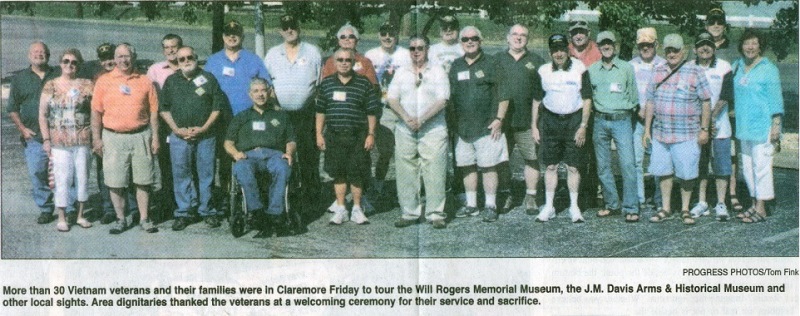
J.M. Davis Arms & Historical Museum was the starting point for a group of nearly 30 Vietnam veterans on Friday, as members of Company C, 1st Battalion, 22nd Infantry gathered in Claremore for a day of sight-seeing.

Escorted into town by members of the Claremore Police Department and the Rogers County Sheriff’s Department, the veterans were greeted by appreciative flag-wavers along Route 66 and in the city limits. “We’re so appreciative for each of you and all you’ve given,” Claremore Mayor Mickey Perry told the veterans at a welcoming ceremony held at the Davis Museum. “Your generation signed up for the draft as you were supposed to. As young men, you received the notice — a notice that started with a greeting and a call which you answered. “The Vietnam Veterans Memorial is engraved with nearly a thousand Oklahomans who gave the ultimate sacrifice — several were from Rogers County, and some were even from Claremore,” he continued. “Your actions were done with honor and courage, and we thank you. It’s necessary to remember and honor the past to ensure our freedoms today and in the future. “Thank you — thank you all for your service for our country,” he said. “Welcome to Claremore, and God bless you all.”

Rep. Marty Quinn, Rogers County Sheriff Scott Walton, Lee Keener and Cara Cowan Watts of the Cherokee Nation, and dignitaries also spoke to and in appreciation of the 31 veterans present, and those absent. The outpouring of appreciation and goodwill was hardly lost on the former soldiers, 28 of whom are Purple Heart recipients. “This has been incredible. I can’t tell you how much we’re all touched to see such a turnout of people thanking us for what we’ve given, wanting to shake our hands and tell us how much our service meant to them,” said veteran Terry Sorvik of Portland, Ore. “Just coming into town and getting the escort that we did — seeing people waving flags at us on our way in — I’ve still got knots in my stomach.” Although the group hosted their reunion in Tulsa, they opted to spend Friday in Claremore, touring the J.M. Davis Arms & Historical Museum, the OMA Museum, Rogers State University, the Will Rogers Memorial Museum, and other local sights. “You all welcomed us to your town to thank us, but I have to say thank you all for helping a bunch of old vets feel remembered and appreciated,” said Jerry Jolly of Norman. “You have no idea how much that means to us.”