Code name for the overwhelming aerial raids of B-52 Stratofortresses against enemy positions in Southeast Asia, the first B-52 Arc Light raid took place on June 18, 1965, on a suspected Vietcong base north of Saigon. Elements of the 2nd and 320th Bombardment Wings, of the Strategic Air Command, had deployed from the United States to Anderson Air Force Base, Guam. Shortly after this strike, the results of which were inconclusive, many Americans began to question the advisability of “swatting flies with sledgehammers.” Such criticism became increasingly common during the eight years of Arc Light operations. Continue reading
Vietnam War
Gulf of Tonkin Incident (1964)
By August 1964, the United States Navy was supporting South Vietnam’s struggle against North Vietnam in two programs.
Operations Plan (OPLAN) 34 involved South Vietnamese naval and marine forces raiding North Vietnamese coastal installations with American advice and logistical support.
Operation DeSoto involved American naval vessels patrolling international waters off the coast of North Vietnam to observe the North Vietnamese Navy and probe the North Vietnamese radar capabilities by electronic surveillance. The destroyer USS Maddox patrolling 28 miles off the North Vietnamese coast as part of DeSoto came under attack by three North Vietnamese torpedo boats on August 2. Continue reading
Vietnam Fighting Methods
What were the methods of fighting in the Vietnam War?
Answer:
III & IV Corps
The southern portion of South Vietnam (Mekong Delta area, III & IV Corps) was mostly hot, humid, swampy, resembling Louisiana and Florida in the United States. This area contained mostly Viet Cong (VC) guerrilla forces. It was too open and too soft to conduct conventional battle; and when the Communists tried to fight in that manner, it often resulted in their quick defeat. This was booby trap, land mine, and sniper, hit & run country.
II Corps
The Central Highlands (II Corps) of South Vietnam approached the terrain and weather of the Midwestern United States; Dry, hilly, hard wood tree forests, creeks & streams, etc. These areas had more organized VC forces, which would conduct the same hit & run ambush tactics, land mines, etc. But, worse, this was mainly NVA territory, where uniformed regular army forces from North Vietnam would establish bases and operations. Big conventional battles would occur in this AO (Area of Operations), “Hamburger Hill”, “Dak To”, “Chu Moor”, and the dreaded A Shau Valley. [Ed Note: This was the area of operations (AO) of Charlie Company]
I Corps
I Corps, was near the DMZ (17th Parallel), this was mainly US Marine Corp territory. They re-took the city of HUE in this AO, during the TET offensive of ’68. I Corps consisted of the Khe Sahn battles, and the first use of NVA tanks (PT-76’s) over-running of the US Green Beret (Special Forces) outpost at Lang Vei in ’68. Many fights in this area were small unit conventional slugging matches with regular NVA units. Small units meaning company sized firefights, (approximately) one hundred men per side.
SOURCE: wiki.answers.com
Tonkin Gulf Resolution
The Senate Debates the Tonkin Gulf Resolution, August 6-7, 1964
To Promote the Maintenance of International Peace and Security in Southeast Asia
Whereas naval units of the Communist regime in Vietnam, in violation of the principles of the Charter of the United Nations and of international law, have deliberately and repeatedly attacked United States naval vessels lawfully present in international waters, and have thereby created a serious threat to international peace; and
Whereas these attacks are part of a deliberate and systematic campaign of aggression that the Communist regime in North Vietnam has been waging against its neighbors and the nations joined with them in the collective defense of their freedom; and
Whereas the United States is assisting the peoples of southeast Asia to protect their freedom and has no territorial, military or political ambitions in that area, but desires only that these people should be left in peace to work out their own destinies in their own way: Now, therefore, be it? Continue reading
It Don’t Mean Nuthin’
It Don’t Mean Nuthin’
by Gary Jacobson © 2003
.
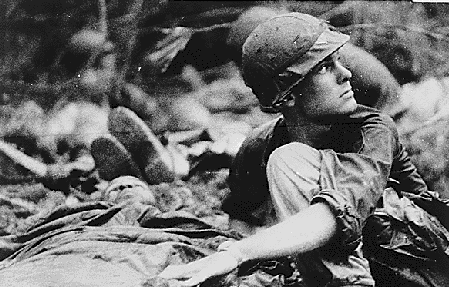 “It Don’t Mean Nuthin’”
A phrase oft repeated in Vietnam, worn paper thin
By soldiers used an awful lot
When it’s gettin’ bricky hot…
Under pressure with lives on the line
Melancholy existence on a definite decline.
“It Don’t Mean Nuthin’, they say”
Turning stone-faced from fears to walk away
As though something’s stolen part of their soul
Left no way sorrow’s grief to console Led too far astray in hell’s battles darkning gray
Forever boyhood humanity to betray…
Staggering memories stored way down deep on the pile
Hidden from the light of day…for awhile!
“But It Don’t Mean Nuthin’” Continue reading
Roots of the Vietnam War
During World War II, Japan invaded and occupied Vietnam, a nation on the eastern edge of the Indochina Peninsula in Southeast Asia that had been under French administration since the late 19th century. Inspired by Chinese and Soviet communism, Ho Chi Minh formed the Viet Minh, or the League for the Independence of Vietnam, to fight both Japan and the French colonial administration. Japan withdrew its forces in 1945, leaving the French-educated Emperor Bao Dai in control of an independent Vietnam. Ho’s Viet Minh forces rose up immediately, seizing the northern city of Hanoi and declaring a Democratic Republic of Vietnam (DRV) with Ho as president.
Seeking to regain control of the region, France backed Bao and set up the state of Vietnam (South Vietnam) in July 1949, with Saigon as its capital. Armed conflict continued until a decisive battle at Dien Bien Phu in May 1954 ended in French defeat by Viet Minh forces. The subsequent treaty negotiations at Geneva split Vietnam along the latitude known as the 17th parallel (with Ho in control in the North and Bao in the South) and called for nationwide elections for reunification to be held in 1956. In 1955, however, the strongly anti-communist Ngo Dinh Diem pushed Bao aside to become president of the Government of the Republic of Vietnam (GVN).
Vietnam War: U.S. Intervention Begins
With the Cold War intensifying, the United States hardened its policies against any allies of the Soviet Union, and by 1955 President Dwight D. Eisenhower had pledged his firm support to Diem and South Vietnam. With training and equipment from American military and police, Diem’s security forces cracked down on Viet Minh sympathizers in the south, whom he derisively called Viet Cong (or Vietnamese Communist), arresting some 100,000 people, many of whom were tortured and executed. By 1957, the Viet Cong and other opponents of Diem’s repressive regime began fighting back with attacks on government officials and other targets, and by 1959 they had begun engaging South Vietnamese Army forces in firefights.
In December 1960, Diem’s opponents within South Vietnam–both communist and non-communist–formed the National Liberation Front (NLF) to organize resistance to the regime. Though the NLF claimed to be autonomous and that most of its members were non-Communist, many in Washington assumed it was a puppet of Hanoi. A team sent by President John F. Kennedy in 1961 to report on conditions in South Vietnam advised a build-up of American military, economic and technical aid in order to help confront the Viet Cong threat. Working under the “domino theory,” which held that if one Southeast Asian country fell to communism, many would follow, Kennedy increased U.S. aid, though he stopped short of committing to a large-scale military intervention. By 1962, the U.S. military presence in South Vietnam had reached some 9,000 troops, compared with fewer than 800 during the 1950s.
Source: Vietnam War. (2012). The History Channel website. Retrieved 6:22, April 6, 2012, from http://www.history.com/topics/vietnam-war.
Casualties by State
CACCF Record Counts by State Home of Record
| State Home of Record | Number of Records |
| Alabama | 1,207 |
| Alaska | 57 |
| Arizona | 623 |
| Arkansas | 588 |
| California | 5,573 |
| Canal Zone | 2 |
| Colorado | 620 |
| Connecticut | 611 |
| Delaware | 122 |
| District of Columbia | 242 |
| Florida | 1,952 |
| Georgia | 1,582 |
| Guam | 70 |
| Hawaii | 276 |
| Idaho | 217 |
| Illinois | 2,934 |
| Indiana | 1,532 |
| Iowa | 853 |
| Kansas | 627 |
| Kentucky | 1,055 |
| Louisiana | 882 |
| Maine | 343 |
| Maryland | 1,014 |
| Massachusetts | 1,323 |
| Michigan | 2,654 |
| Minnesota | 1,072 |
| Mississippi | 637 |
| Missouri | 1,413 |
| Montana | 268 |
| Nebraska | 395 |
| Nevada | 151 |
| New Hampshire | 227 |
| New Jersey | 1,484 |
| New Mexico | 399 |
| New York | 4,121 |
| North Carolina | 1,609 |
| North Dakota | 198 |
| Ohio | 3,096 |
| Oklahoma | 988 |
| Oregon | 709 |
| Pennsylvania | 3,144 |
| Puerto Rico | 345 |
| Rhode Island | 207 |
| South Carolina | 896 |
| South Dakota | 193 |
| Tennessee | 1,291 |
| Texas | 3,415 |
| Utah | 366 |
| Vermont | 100 |
| Virgin Islands | 15 |
| Virginia | 1,304 |
| Washington | 1,050 |
| West Virginia | 732 |
| Wisconsin | 1,161 |
| Wyoming | 120 |
| Other (non-U.S. home of record) | 121 |
| Total | 58,193 |
Record counts provided for informational purposes only, not official statistics
 Charlie Company Vietnam 1966-1972