When Did the Vietnam War Start and End?

When Did the Vietnam War Start and End?

Possible Answers:

It started in 1954 (the same year the Algerian War for Independence from France began) and ended in 1975. It went on longer in Vietnam until the North Vietnamese took over South Vietnam and made the entire country communist governed. The Vietnamese had been fighting for a lot longer than before the United States stepped in to help.

1. If one could think about direct army involvement then it would be Oct. 27, 1932 U.S. establishes the Military Assistance Advisory Group, Indochina (MAAG) in Saigon to aid the French military (the French had been fighting communist rebels in Vietnam, their pre-WWII colony, since 1945 A.D.).

2. If one could think about direct combat engagement then it would be November 1, 1955 — The U.S. re designates MACG, Indochina, as MACG, Vietnam to specify its new direct combat advisory role with the North Vietnamese Army. The U.S. essentially took over the advisory role from the French, who were leaving Vietnam after their defeat at Diem Bi en Po in 1954. The Department of Defense views this date as the latest qualifying date for inclusion on the Vietnam Veterans Memorial. In fact this allows US military personnel to use live weapons in Vietnam aka ‘to win’!

3. March 1959 — Ho Chi Minh declares a People’s War to unite all of Vietnam under his leadership. His Politburo orders a changeover to an all-out military struggle. From the communist perspective, the “Vietnam War” against the U.S. has now officially started.

4. December 11, 1961 — US. Aircraft carrier “Core” arrives in Saigon with 65 helicopters and 4000 air and ground crewmen assigned to operate them for the North Vietnamese Army. Also, US. Pilots start to train & fly support missions with the North Vietnamese Air Force. This really marks the first larger scale participation of U.S. military “advisers.

5. August 7, 1964 — In response to the incidents involving U.S. naval vessels USS. Maddox and the USS. Turner Joy, the U.S. Congress overwhelmingly passes the “Gulf of Ton-kin Resolution,” allowing the President “to take all necessary steps, including the use of armed force” to prevent further attacks against U.S. forces. Many people view this as the “official” start of the war, although there was never a declaration of war.

6. March 8, 1965 — The first U.S. combat troops arrive in Vietnam, as 3,500 Marines land at China Beach to defend the American air base at Da Nang. They join 23,000 American military advisers already in Vietnam. The arrival of combat troops is considered by some the start of the war, although American military advisers have been in Vietnam for over 10 years. Continue reading
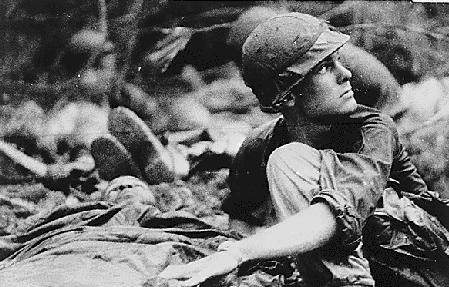
It Don’t Mean Nuthin’

It Don’t Mean Nuthin’

by Gary Jacobson © 2003

.

“It Don’t Mean Nuthin’”
A phrase oft repeated in Vietnam, worn paper thin
By soldiers used an awful lot
When it’s gettin’ bricky hot…
Under pressure with lives on the line
Melancholy existence on a definite decline.

“It Don’t Mean Nuthin’, they say”
Turning stone-faced from fears to walk away
As though something’s stolen part of their soul
Left no way sorrow’s grief to console Led too far astray in hell’s battles darkning gray
Forever boyhood humanity to betray…
Staggering memories stored way down deep on the pile
Hidden from the light of day…for awhile!
“But It Don’t Mean Nuthin’” Continue reading

The Draft

In 1940 Congress passed the Selective Training and Service Act which created the first peacetime draft and established the Selective Service System as an independent federal agency.

Conscription in the United States has been employed several times, usually during war but also during the nominal peace of the Cold War. However, the Selective Service System remains in place as a contingency plan; men between the ages of 18 and 25 are required to register so that a draft can be readily resumed if needed. In current conditions conscription is considered unlikely by most political and military experts. Continue reading

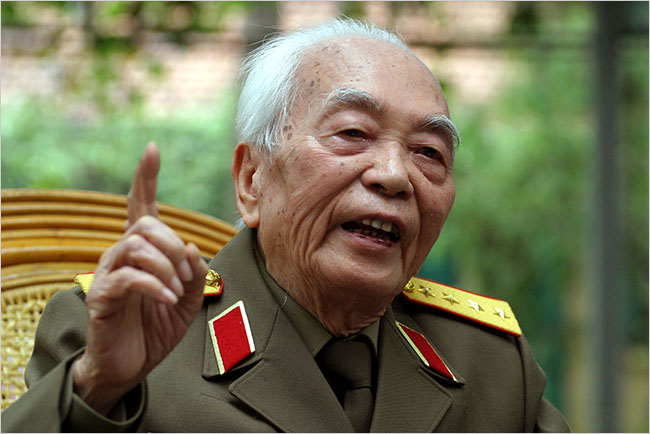
General Vo Nguyen Giap

General Giap was a brilliant, highly respected leader of the North Vietnam military. The following quote is from his memoirs currently found in the Vietnam war memorial in Hanoi :

What we still don’t understand is why you Americans stopped the bombing of Hanoi. You had us on the ropes. If you had pressed us a little harder, just for another day or two, we were ready to surrender! It was the same at the battle of TET. You defeated us!

We knew it, and we thought you knew it. But we were elated to notice your media was helping us. They were causing more disruption in America than we could in the battlefields. We were ready to surrender.

You had won!

General Giap has published his memoirs and confirmed what most Americans knew. The Vietnam war was not lost in Vietnam : it was lost at home. The same
slippery slope, sponsored by the U.S. media, is currently underway. It exposes the enormous power of a Biased Media to cut out the heart and will of the American public.

A truism worthy of note: . . . Do not fear the enemy, for they can take only your life. Fear the media, for they will destroy your honor.

One fine man probably summarized it best…

It is the soldier, not the reporter, Who has given us freedom of the press.

It is the soldier, not the poet, Who has given us freedom of speech.

It is the soldier, not the campus organizer, Who has given us the freedom to demonstrate.

It is the soldier, Who salutes the flag, Who serves beneath the flag, and whose coffin is draped by the flag, Who allows the protester to burn the flag.”

Father Denis Edward O’Brien, USMC

The Real Rambo

Robert Howard

.

Robert Lewis Howard (July 11, 1939 – December 23, 2009) was a highly decorated United States Army soldier and Medal of Honor recipient of the Vietnam War. He was wounded 14 times over 54 months of combat, was awarded 8 Purple Hearts, 4 Bronze Stars, and was nominated for the Medal of Honor three separate times. He was laid to rest at Arlington National Cemetery on February 22, 2010.

Howard enlisted in the Army at Montgomery, Alabama and retired as Colonel.

As a staff sergeant of the highly-classified Military Assistance Command, Vietnam – Studies and Observations Group (MACV-SOG), Howard was recommended for the Medal of Honor on three separate occasions for three individual actions during thirteen months spanning 1967–1968. The first two nominations were downgraded to a Silver Star and the Distinguished Service Cross due to the covert nature of the operations in which Howard participated. As a Sergeant First Class of the same organization, he risked his life during a rescue mission in Cambodia on December 30, 1968, while second in command of a platoon-sized Hornet Force that was searching for missing American soldier Robert Scherdin, and was finally awarded the Medal of Honor. He learned of the award over a two-way radio while under enemy fire, immediately after being wounded, resulting in one of his eight Purple Hearts.

Howard was wounded 14 times during one 54-month period during the Vietnam War. He received two Masters degrees during his government career which spanned almost 50 years. Howard retired as a full Colonel in 1992. His Army career spanned 1956 to 1992.

According to NBC News, Howard may have been the most highly-decorated American soldier since World War II. His residence was in Texas and he spent much of his free time working with veterans at the time of his death. He also took periodic trips to Iraq to visit active duty troops.

Howard died of pancreatic cancer at a hospice in Waco, Texas on December 23, 2009. He was survived by four children and four grandchildren. His funeral was in Arlington National Cemetery on 22 February 2010.

SOURCE: Wikipedia

Rules for Saluting US Flag

Law Now Allows Retirees and Vets to Salute Flag

Traditionally, members of the nation’s veterans service organizations have rendered the hand-salute during the national anthem and at events involving the national flag only while wearing their organization’s official head-gear.

The National Defense Authorization Act of 2008 contained an amendment to allow un-uniformed service members, military retirees, and veterans to render a hand salute during the hoisting, lowering, or passing of the U.S. flag.

A later amendment further authorized hand-salutes during the national anthem by veterans and out-of-uniform military personnel. This was included in the Defense Authorization Act of 2009, which President Bush signed on Oct. 14, 2008. Continue reading

The History of Flag Day

The first celebration of the U.S. Flag’s birthday was held in 1877 on the 100th anniversary of the Flag Resolution of 1777.

However, it is believed that the first annual recognition of the flag’s birthday dates back to 1885 when school teacher, BJ Cigrand, first organized a group of Wisconsin school children to observe June 14 – the 108th anniversary of the official adoption of The Stars and Stripes as the Flag’s Birthday. Cigrand, now known as the ‘Father of Flag Day,’ continued to publically advocate the observance of June 14 as the flag’s ‘birthday’, or ‘Flag Day’ for years. Continue reading

Rangers: First Leaders of America’s Army

FORT MEADE, Md. — When Congress established the Continental Army on June 14, 1775, the original 10 Rifle Companies were composed heavily of frontiersmen and some of the militia leaders already fighting were veterans of a unit known as Roger’s Rangers.

Roger’s Rangers were skilled woodsmen who fought for the British during the French and Indian War. They frequently undertook winter raids against French outposts, blended native-American techniques with pioneering skills and operated in terrain where traditional militias were ineffective.

The American ranger tradition actually began back in the early 17th century on the frontier, according to historian Glenn Williams at the U.S. Army Center of Military History. Continue reading

The Army’s Birthday: 14 June 1775

When the American Revolution broke out, the rebellious colonies did not possess an army in the modern sense. Rather, the revolutionaries fielded an amateur force of colonial troops, cobbled together from various New England militia companies. They had no unified chain of command, and although Artemas Ward of Massachusetts exercised authority by informal agreement, officers from other colonies were not obligated to obey his orders. The American volunteers were led, equipped, armed, paid for, and supported by the colonies from which they were raised. Continue reading