The First Battle of Vietnam

This is a highlight of the first Army battle in the Ia Drang Valley of Vietnam in 1965. This battle was brought to light in a book authored by Col. Hal Moore, battalion commander, and made into a movie “We Were Soldiers Once and Young”. One of the officers who participated in this battle gives his summary of what happened.  Note the odds, 2400 of the enemy engaging with about 400 of our soldiers.

Thanks to Jim D for the link. Hooah

Opposition to the Vietnam War Part VIII

Clergy

The clergy, often a forgotten group during the opposition to the Vietnam War, played a large role as well. The clergy covered any of the religious leaders and members including individuals such as Martin Luther King Jr. In his speech “Beyond Vietnam” King stated, “the greatest purveyor of violence in the world today: my own government. For the sake of those boys, for the sake of this government, for the sake of the hundreds of thousands trembling under our violence, I cannot be silent.” King was not looking for racial equality through this speech, but tried to voice for an end to the war instead.

The involvement of the clergy did not stop at King though. The analysis entitled “Social Movement Participation: Clergy and the Anti-Vietnam War Movement” expands upon the anti-war movement by taking King, a single religious figurehead, and explaining the movement from the entire clergy’s perspective. The clergy were often forgotten though throughout this opposition. The analysis refers to that fact by saying, “The research concerning clergy anti-war participation is even more barren than the literature on student activism.”  There is a relationship and correlation between theology and political opinions and during the Vietnam War, the same relationship occurred between feelings about the war and theology. This article basically was a social experiment finding results on how the pastors and clergy members reacted to the war. Based on the results found, they most certainly did not believe in the war and wished to help end it.

Another source, Lift Up Your Voice Like A Trumpet: White Clergy And The Civil Rights And Antiwar Movements, 1954–1973 explains the story of the entire spectrum of the clergy and their involvement. Michael Freidland is able to completely tell the story in his chapter entitled, “A Voice of Moderation: Clergy and the Anti-War Movement: 1966–1967”. In basic summary, each specific clergy from each religion had their own view of the war and how they dealt with it, but as a whole, the clergy was completely against the war.

Opposition to the Vietnam War Part VII

African Americans

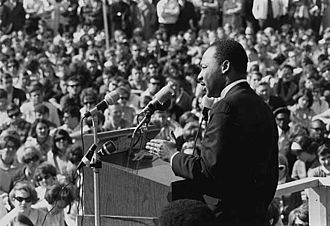
Martin Luther King, Jr. speaking to an anti-Vietnam War rally at the University of Minnesota, St. Paul on April 27, 1967

330px-Martin_Luther_King_Jr_St_Paul_Campus_U_MN

African Americans were often involved in the Civil Rights Movement and the antiwar movement. Martin Luther King, Jr. and James Bevel of the Southern Christian Leadership Conference (SCLC) were prominent opponents of the Vietnam War, and the Black Panther Party vehemently opposed U.S. involvement in Vietnam. In the beginning of the war, some African Americans did not want to join the war opposition movement because of loyalty to President Johnson for pushing Civil Rights legislation, but soon the escalating violence of the war and the perceived social injustice of the draft propelled involvement in antiwar groups. Black antiwar groups opposed the war for the same reason as white groups, but often protested in separate events and did not cooperate with the ideas of white antiwar leadership. They harshly criticized the draft because poor and minority men were usually most affected by conscription although the Washington Post in a 1986 in depth examination of who actually fought the Vietnam War entitled “The Myth of the Vietnam Vet” contradicted this assertion. According to the Post, “The man who fought in Vietnam is typically depicted as a draftee, unwilling and probably black. In fact, 73 percent of those who died were volunteers and 12.5 percent were black (out of an age group that comprised 13.5 percent of the male population).” African Americans involved in the antiwar movement often formed their own groups, such as Black Women Enraged, National Black Anti-War Anti-Draft Union, and National Black Draft Counselors. Within these groups, however, many African American women were seen as subordinate members by black male leaders. Many African American women viewed the war in Vietnam as racially motivated and sympathized strongly with Vietnamese women. Such concerns often propelled their participation in the antiwar movement and their creation of new opposition groups.

Opposition to the Vietnam War Part VI

Women

Women were a large part of the antiwar movement, even though they were sometimes relegated to second-class status within the organizations or faced sexism within opposition groups. Some leaders of anti-war groups viewed women as sex objects or secretaries, not actual thinkers who could contribute positively and tangibly to the group’s goals, or believed that women could not truly understand and join the antiwar movement because they were unaffected by the draft. Women involved in opposition groups disliked the romanticism of the violence of both the war and the antiwar movement that was common amongst male war protestors. Despite the inequalities, participation in various antiwar groups allowed women to gain experience with organizing protests and crafting effective antiwar rhetoric. These newfound skills combined with their dislike of sexism within the opposition movement caused many women to break away from the mainstream antiwar movement and create or join women’s antiwar groups, such as Another Mother for Peace, Women’s International League for Peace and Freedom (WILPF), and Women Strike for Peace (WSP), also known as Women For Peace. Female soldiers serving in Vietnam joined the movement to battle the war and sexism, racism, and the established military bureaucracy by writing articles for antiwar and antimilitary newspapers.

Mothers and older generations of women joined the opposition movement, as advocates for peace and people opposed to the effects of the war and the draft on the generation of young men. These women saw the draft as one of the most disliked parts of the war machine and sought to undermine the war itself through undermining the draft. Another Mother for Peace and WSP often held free draft counseling centers to give young men legal and illegal methods to oppose the draft. Members of Women For Peace showed up at the White House every Sunday for 8 years from 11 to 1 for a peace vigil. Such female antiwar groups often relied on maternalism, the image of women as peaceful caretakers of the world, to express and accomplish their goals. The government often saw middle-aged women involved in such organizations as the most dangerous members of the opposition movement because they were ordinary citizens who quickly and efficiently mobilized.

Many women in America sympathized with the Vietnamese civilians affected by the war and joined the opposition movement. They protested the use of napalm, a highly flammable jelly weapon created by Dow Chemical Company and used as a weapon during the war, by boycotting Saran Wrap, another product made by the company.

Faced with the sexism sometimes found in the antiwar movement, New Left, and Civil Rights Movement, some women created their own organizations to establish true equality of the sexes. Some of frustrations of younger women became apparent during the antiwar movement: they desired more radical change and decreased acceptance of societal gender roles than older women activists. Female activists’ disillusion with the antiwar movement led to the formation of the Women’s Liberation Movement to establish true equality for American women in all facets of life.
Opposition to the Vietnam War Part V

Arts

Many artists during the 1960s and 1970s opposed the war and used their creativity and careers to visibly oppose the war. Writers and poets opposed to involvement in the war included Allen Ginsberg, Denise Levertov, Robert Duncan, and Robert Bly. Their pieces often incorporated imagery based on the tragic events of the war as well as the disparity between life in Vietnam and life in the United States. Visual artists Ronald Haeberle, Peter Saul, and Nancy Spero, among others, used war equipment, like guns and helicopters, in their works while incorporating important political and war figures, portraying to the nation exactly who was responsible for the violence. Filmmakers such as Lenny Lipton, Jerry Abrams, Peter Gessner, and David Ringo created documentary-style movies featuring actual footage from the antiwar marches to raise awareness about the war and the diverse opposition movement. Playwrights like Frank O’Hara, Sam Shepard, Robert Lowell, Megan Terry, Grant Duay, and Kenneth Bernard used theater as a vehicle for portraying their thoughts about the Vietnam War, often satirizing the role of America in the world and juxtaposing the horrific effects of war with normal scenes of life. Regardless of medium, antiwar artists ranged from pacifists to violent radicals and caused Americans to think more critically about the war. Art as war opposition was quite popular in the early years of the war, but soon faded as political activism became the more common and most visible way of opposing the war.