Posts
The Rules of Engagement
The Rules of Engagement in the 2nd Indochina War (Vietnam)
Share
By Paul Schmehl
This is a subject that is little known or discussed among the so-called experts on the war but had a significant impact on its outcome. While it is well known that Washington micromanaged the war (thus the famous story about LBJ boasting that the military couldn’t bomb an outhouse without his approval 1), the details of what that meant are not as well-known. When viewed through the lens of military strategy they border on the insane.
The rules of engagement were drawn from three different sources; the President and Secretary of Defense, through the Joint Chiefs of Staff, the Commander of the Military Assistance Command and the Commander-in-Chief, Pacific Command. Except if you were operating in Laos. Then the State Department set the rules.2 3 4
There are two primary facets to the rules of engagement; the air war and the ground war. The following are lawful targets according to the laws of war. 5
- Military complexes equipment and supplies
- Economic power industrial (war supporting/import/export)
- transportation (equipment/lines of communication/petroleum)
- Political
- Geographic
- Personnel military civilians participating in hostilities
The targets that the US military were permitted to attack from the air per Secretary McNamara were
- Transportation
- Military outside of populated areas
Air War 6
- Pilots could not attack targets that were not on the approved list. Hanoi and Haiphong had 30 mile perimeters that were no bombing zones.
- A 30 mile perimeter on the northern border of North Vietnam prevented pursuit of attacking MIG fighters
- Rail yards and switching stations were off-limit
- Airfields were off-limits
- MIGs could only be shot at if they were airborne, clearly identified and displayed hostile intentS
- SAM sites could only be attacked if they attacked first
- SAM sites and antiaircraft sites could not be attacked while they were under construction
- Locks, dams and dikes could never be attacked
- Hydroelectric plants could not be attacked
- Military targets could not be attacked if they were in protected zones
- Trucks in Laos and North Viet Nam could not be attacked unless they were on a road and displayed hostile intent
- Military truck parks more than 200 meters from a road could not be attacked
- Pilots had to travel routes specified by Washington and would face court-martial if they disobeyed.
- The PAVN knew these routes and placed all their antiaircraft defenses on those routes, forcing American pilots to run a gauntlet of enemy fire to complete their missions.
- They were forced to fly over targets in weather so bad they could not release their bombs but still had to face the enemy’s radar controlled ground fire.
- Pilots in South Viet Nam could not provide air support to ground troops, even if fired upon, unless they got clearance, and they first had to drop leaflets warning possible civilians to clear the area.
- The average time in Laos between the discovery of a target and permission to strike was fifteen days!
Senator John Stennis, Chairman of the Preparedness Investigating Subcommittee of the Senate Armed Services Committee, stated, in 1967, “That the air campaign has not achieved its objectives to a greater extent cannot be attributed to impotence or inability of air power. It attests, rather, to the fragmentation of our air might by overly restrictive controls, limitations, and the doctrine of ‘gradualism’ placed on our aviation forces which prevented them from waging the air campaign in the manner and according to the timetable which was best calculated to achieve maximum results.” 7
The Subcommittee found that Secretary of Defense McNamara and President Lyndon Johnson had “discounted the unanimous professional judgment of U.S. commanders and the Joint Chiefs of Staff, and substituted civilian judgment in the details of target selection and the timing of strikes.” 8
In 1972, President Nixon authorized all of the targets that the JCS requested with the exception of three. The results were reported by Admiral Stockdale, who was a prisoner of war in the Hanoi Hilton at the time.
At dawn, the streets of Hanoi were absolutely silent. The usual patriotic wakeup music was missing. The familiar street sounds, the horns, all gone. In prison, interrogators and guards would inquire about our needs solicitously. Unprecedented morning coffee was delivered to our cell blocks. One look at any Vietnamese officer’s face told the whole story. It telegraphed accommodation, hopelessness, remorse, fear. The shock was there; our enemy’s will was broken. The sad thing was that we all knew what we were seeing could have been done in any 10-day period in the previous seven years and saved lives of thousands, including most of those 57,000 dead Americans. 9
Ground War 10
- Commanders in direct contact with the enemy in uninhabited areas could request direct artillery fire without prior authorization.
- Commanders in direct contact with the enemy in inhabited areas could only authorize direct fire if their mission was in jeopardy and the enemy was positively identified and only for defensive purposes.
- Indirect fire could only be utilized after approval of the Province Chief for the province where the fire would be directed.
- No artillery could be fired in areas where friendly troops were not operating without the prior use of leaflets or loudspeakers, even if enemy fire was received from the area
- Direct fire against enemy forces that were not in direct contact in inhabited areas required approval of both the Province Chief and the battalion commander
- Indirect fire missions in inhabited areas required the approval of the Province Chief, the battalion commander and the dropping of leaflets or the use of loudspeakers to warn civilians prior to commencement
- Cordon and search missions could only be conducted with the approval of the district and village chief as well as the US commander, and RVN advisors must accompany all missions
- Attacks in inhabited areas required that the commander explain to the inhabitants why the action was initiated, after the attack was over
- Fleeing enemy troops could not be engaged unless they were first ordered to halt and failed to obey. Then they must be fired upon with the intent to wound only, by firing at the lower extremities.
- The much discussed “free fire zones” had to have prior approval from RVN political authorities and were still restricted by all the other rules of engagement.
Senator Barry Goldwater was so appalled by the rules of engagement that he had them entered into the Congressional Record along with this statement.
Mr. GOLDWATER. Mr. President, I ask this because I think it 1s very, very necessary for the Members of this body. the public, the press, and media to understand fully the restrictions that were placed upon aU of our forces in South Vietnam.
It is absolutely unbelievable that any Secretary of Defense would ever place such restrictions on our forces. It Is unbelievable that any President would have allowed this to happen.
I think on the reading of these restrictions, members of this body will begin to understand in a better way just what happened to the American military power in South Vietnam. As I say, it is unbelievable.
I am ashamed of my country for having had people who would have allowed such restrictions to have been placed upon men who were trained to fight, men who were trained to make decisions to win war, and men who were risking their lives. I daresay that these restrictions had as much to do with our casualties as the enemy themselves.
- Broughton, Jacksel, and John D. Lavelle. “Air Force Colonel Jacksel ‘Jack’ Broughton & Air Force General John D. ‘Jack’ Lavelle: Testing the Rules of Engagement During the Vietnam War.” HistoryNet. History.net, 12 June 2006. Web. 26 Dec. 2016. <http://www.historynet.com/air-force-colonel-jacksel-jack-broughton-air-force-general-john-d-jack-lavelle-testing-the-rules-of-engagement-during-the-vietnam-war.htm>.
- Emerson, J. Terry. “Making War Without Will: Vietnam Rules of Engagement.” The Vietnam Debates: A Fresh Look at the Arguments. New York: U of America, 1990. 161-70. Print.
- USAF Ops from Thailand Jan 67 – Jul 1968 (Part 1), Undated, Folder 01, Bud Harton Collection, The Vietnam Center and Archive, Texas Tech University. Accessed 23 Dec. 2016. <http://www.vietnam.ttu.edu/virtualarchive/items.php?item=168300010948>.
- Congressional Record – Senate on “U.S. Rules of Engagement in Vietnam War – 1969-1972”, 1985, Folder 05, Box 52, Douglas Pike Collection: Unit 03 – Legal and Legislative, The Vietnam Center and Archive, Texas Tech University. Accessed 23 Dec. 2016. <http://www.vietnam.ttu.edu/virtualarchive/items.php?item=2185205001>.
- Parks, W. Hays. “The Bombing of North Vietnam and the Law of War.” The Vietnam Debates: A Fresh Look at the Arguments. New York: U of America, 1990. 172-73. Print.
- Broughton, Jacksel M.. “Rolling Thunder from the Cockpit.” The Vietnam Debates: A Fresh Look at the Arguments. New York: U of America, 1990. 149-60. Print.
- Staff of Senate Committee on Armed Services, Preparedness Investigating Committee, Air War Against North Vietnam, 90th Congress, 1st Session, at 2 (1967).
- Emerson, J. Terry. “Making War Without Will: Vietnam Rules of Engagement.” The Vietnam Debates: A Fresh Look at the Arguments. New York:.
- Parks, W. Hays. “The Bombing of North Vietnam and the Law of War.” The Vietnam Debates: A Fresh Look at the Arguments. New York: U of America, 1990. 179. Print.
- US Military ” Rules of Engagement”, January 1975, Folder 11, Box 51, Douglas Pike Collection: Unit 03 – Legal and Legislative, The Vietnam Center and Archive, Texas Tech University. Accessed 23 Dec. 2016. <http://www.vietnam.ttu.edu/virtualarchive/items.php?item=2185111001>.
Courtesy of Randy C. Hooah
The Pentagon Papers
The Pentagon Papers was the name given to a secret Department of Defense study of U.S. political and military involvement in Vietnam from 1945 to 1967, prepared at the request of Secretary of Defense Robert McNamara in 1967. As the Vietnam War dragged on and the U.S. military presence in South Vietnam increased to more than 500,000 troops by 1968, the military analyst Daniel Ellsberg (who had worked on the study) came to oppose the war, and decided that the information contained in the Pentagon Papers should be more widely available to the American public. He secretly photocopied the report and in March 1971 gave the copy to The New York Times, which subsequently published a series of articles based on the report’s findings. Amid the national and international uproar that followed, the federal government tried unsuccessfully to block publication of the Pentagon Papers on grounds of national security. Continue reading
William Westmoreland
President Lyndon Johnson chose William Westmoreland, a distinguished veteran of World War II and the Korean War, to command the U.S. Military Assistance Command in Vietnam (MACV) in June 1964. Over the next four years, the general directed much of U.S. military strategy during the Vietnam War, spearheading the buildup of American troops in the region from 16,000 to more than 500,000. His strategy of attrition aimed to inflict heavy losses on North Vietnamese and Viet Cong forces using superior U.S. firepower, but resulted in a costly stalemate by late 1967.
The enemy’s ambitious Tet Offensive in early 1968 cast serious doubt on Westmoreland’s claims of progress in the war effort, even as he called for some 200,000 more troops. Growing antiwar sentiment on the home front led President Johnson to halt bombing attacks on North Vietnam in March 1968, and in June he replaced Westmoreland in command of the MACV. Back in the United States, Westmoreland fought off criticisms of his conduct of the war (including a libel lawsuit against CBS News) and became a dedicated supporter of Vietnam veterans. Continue reading
Famous American Vietnam Vets
Of the nearly 1 million Americans who served on active duty in the U.S. Armed Forces during the Vietnam War era (1964-75), many were or went on to become famous in diverse fields such as politics, entertainment, sports and journalism. The young Navy pilot John McCain, son of a four-star admiral, spent five and a half years as a prisoner of war in Vietnam before going on to become a longtime senator from Arizona and a Republican presidential candidate. Oliver Stone, who served in an infantry division in Vietnam for 15 months, drew on his experience in the war for films like “Platoon” (1986) and “Born on the Fourth of July” (1989), both of which earned him Academy Awards for Best Director. These men are just two of the most famous American veterans of the Vietnam War. Continue reading
Weapons of the Vietnam War
From air power to infantry to chemicals, the weapons used in the Vietnam War were more devastating than those of any previous conflict. United States and South Vietnamese forces relied heavily on their superior air power, including B-52 bombers and other aircraft that dropped thousands of pounds of explosives over North Vietnam and Communist targets in South Vietnam. While U.S. troops and their allies used mainly American-manufactured weapons, Communist forces used weapons manufactured in the Soviet Union and China. In addition to artillery and infantry weapons, both sides utilized a variety of tools to further their war aims, including highly toxic chemical defoliants or herbicides (on the U.S. side) and inventive booby traps using sharpened bamboo sticks or crossbows triggered by tripwires (on the North Vietnamese-Viet Cong side). Continue reading
Guerrilla Tactics
The Vietcong
The Vietnamese Communists, or Vietcong, were the military branch of the National Liberation Front (NLF), and were commanded by the Central Office for South Vietnam, which was located near the Cambodian border. For arms, ammunition and special equipment, the Vietcong depended on the Ho Chi Minh trail. Other needs were met inside South Vietnam.

Main force Vietcong units were uniformed, full-time soldiers, and were used to launch large scale offensives over a wide area. Regional forces were also full-time, but operated only within their own districts. When necessary, small regional units would unite for large scale attacks. If enemy pressure became too great, they would break down into smaller units and scatter. Unlike the main troops, who saw themselves as professional soldiers, local Vietcong groups tended to be far less confident.
For the most part, recruits were young teenagers, and while many were motivated by idealism, others had been pressured or shamed into joining. They also harbored real doubts about their ability to fight heavily armed and well-trained American soldiers.Initially, local guerrillas were given only a basic minimum of infantry training, but if they were recruited to a main force unit, they could receive up to a month of advanced instruction. Additionally, there were dozens of hidden centers all over South Vietnam for squad and platoon leader, weapons and radio training.
To ensure that the guerrillas understood why they were fighting, all training courses included political instruction. By the mid-1960s, most main force Vietcong troops were armed with Chinese versions of the Russian AK-47 submachine gun. They also used a range of effective Soviet and Chinese light and medium machine guns, and infrequently, heavy machine guns. In particular, heavy machine guns were valued for defense against American helicopters.
For destroying armored vehicles or bunkers, the Vietcong had highly effective rocket propelled grenades and recoilless rifles. Mortars were also available in large numbers and had the advantage of being very easy to transport.
Many weapons, including booby traps and mines, were homemade in villages. The materials ranged from scavenged tin can to discarded wire, but the most important ingredients were provided by the enemy. In a year, dud American bombs could leave more than 20,000 tons of explosives scattered around the Vietnamese countryside. After air-raids, volunteers retrieved the duds and the dangerous business of creating new weapons began.
Local forces also designed primitive weapons, some designed to frighten intruders, but others were extremely dangerous. “Punji traps” — sharp spikes hidden in pits — could easily disable an enemy soldier. Punjis were often deliberately contaminated to increase the risk of infection.
Guerrilla Tactics
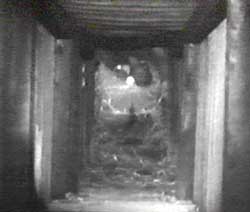
In December 1965, Ho Chi Minh and the North Vietnamese leadership ordered a change in a way the war in the South was to be fought. From now on, the Vietcong would avoid pitched battles with the Americans unless the odds were clearly in their favor. There would be more hit and run attacks and ambushes.
To counter the American build-up, Vietcong recruitment would be stepped up and more North Vietnamese Army troops would be infiltrated into South Vietnam.The Vietcong, following the example of Chinese guerillas before them, had always given the highest priority to creating safe base areas. They were training grounds, logistics centers and headquarters. They also offered secure sanctuaries for times when the war might go badly.
Hiding the base areas had always been a high priority for the Vietcong. Now, with American spotter planes everywhere, it was more vital than ever to protect them. In remote swamps or forests, there were few problems, but nearer the capital, it was much more difficult. The answer was to build enormous systems of underground tunnels.
The orders coming from NLF headquarters were absolutely clear. Tunnels were not to be treated as mere shelters. They were fighting bases capable of providing continuous support for troops. Even if a village was in enemy hands, the NLF beneath were still able to conduct offensive operations.
There were complexes big and small scattered across the country. Each villager in a NLF area had to dig three feet of tunnel a day. There was even a standard handbook specifying how tunnels were to be built. The biggest tunnel systems were in the Iron Triangle and the Cu Chi District, only 20 miles from Saigon.
Close-up: Cu Chi
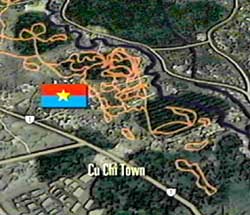
The base area at Cu Chi was a vast network, with nearly 200 miles of tunnels. Any facility used by the guerillas — a conference room or training area — had almost immediate underground access. Hidden trapdoors led below, past guarded chambers, to long passages. At regular intervals, branches led back to the surface and other secret entrances.
Some openings were even concealed beneath the waters of streams or canals.At the deeper levels, there were chambers carved out for arms factories and a well for the base’s water supply. There were store rooms for weapons anad rice, and there was sometimes a hospital or forward aid station. Long communication tunnels connected the base with other distant complexes.
Base kitchens were always near the surface, with long, carved-out chimneys designed to diffuse cooking smoke and release it some distance away. Near the kitchens were the guerilla’s sleeping chambers, where they could survive for weeks at a time if need be. Everywhere on the top level, there were tunnels leading upwards to hundreds of hidden firing posts for defense of the base.
Source: PBS.org/Battlefield Vietnam
 Charlie Company Vietnam 1966-1972