Author: Fast Freddy


Getting VA Claims to the Right Place
Week of January 13, 2014
The Department of Veterans Affairs is transforming to better serve our nation’s veterans. By funneling veterans’ claims through the new Intake Processing Centers (IPC) at VA, VA is looking to make sure the right claims get to the right lane at the right time, improving accuracy and moving claims faster. To learn more, watch the Department of Veterans Affairs (VA) video.
Slip and Fall Off a Curb
You gotta watch when you step off the curb….
This poor guy ran into a few Marines before he stabbed one of the 4 – BIG mistake – then ‘slipped and fell’ off the curb. Hoo-Rah!
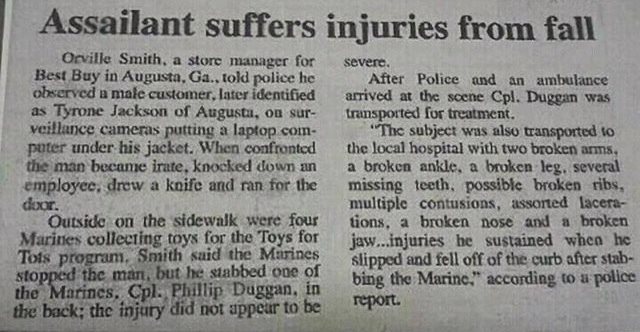

Click above for larger view
Thanks to Chuck Z – HooRah
Vietnam-Era Zippo Lighters As Works Of Art
In one Santa Barbara, California gallery, the portraits bring back memories for Vietnam vet Hap Desimone. But they’re not portraits of soldiers, they’re portraits of Zippo lighters.
CBS News correspondent John Blackstone asked him if it seems strange to see the lighters depicted as art.”No,” he says. “It doesn’t seem strange at all.” In Vietnam, every soldier, it seemed, had a Zippo. “I carried one,” Desimone says. “I had it engraved.”With the engravings Zippos became the one place soldiers could express themselves.”A lot of these sentiments I heard before, ‘We’re the unwilling led by the unqualified doing the unnecessary for the ungrateful’,” he says. “It rings a bell.”Zippos by the thousands were left behind in Vietnam. Fifteen years ago artist Bradford Edwards began collecting them at Vietnamese flea markets.
“Here’s an interesting one,” Edwards says, “a broken peace sign on a bracelet.”
In a new book chronicling his work, Edwards explains that each Zippo tells a story – the disgruntled soldier, the lonely soldier, the bored soldier. Edwards became captivated by the engraved Zippos and began recreating them in his own art: larger than life portraits in metal, in stone, in lacquer and mother of pearl.
“When they’re done in this artistic fashion, I think they celebrate and extol the virtues and highlight the carving,” Edwards says.
Just the sound of a Zippo opening is iconic, and Zippos sparked controversy in one of the most famous images from Vietnam.
After Morley Safer reported in August 1965 that a village was lit on fire with lighters, the Zippo became an image of a war going the wrong way. But to Edwards the Zippos are not about the big issues, but about the individual soldier.
“You had people who were discontent people who wanted to express heartfelt emotions,” he says. “And here was a small canvas.”
“They look like a collection of tombstones,” Edwards says. “And they maybe the last thing some of these guys had to say.”
While some of the soldiers may never have made it home, now their Zippos are here illuminating the past.
CLICK to see the news report
Nixon considered using nukes against North Vietnam
Nixon considered using nukes against North Vietnam, declassified documents show
WASHINGTON – President Nixon, in his first year in office and eager to end an unpopular war that killed tens of thousands of U.S. troops, considered using nuclear weapons against the North Vietnamese, recently declassified documents show. By mid-1969, Nixon and national security adviser Henry Kissinger had settled on a strategy using international diplomacy with threats of force against the communists ruling the north in an attempt to get them to buckle, according to an analysis of the papers by the National Security Archive. The private research group is headquartered at George Washington University.
Kissinger and his staff began developing contingency military plans under the code name of “Duck Hook.” He also created a committee within the National Security Council to evaluate secret plans prepared by Joint Chiefs of Staff in Washington and military planners in Saigon. A pair of declassified documents raised the question of nuclear weapons use in connection with the military operation against the north, which was fighting to reunite with the democratic south, according to the archive.
The first is a Sept. 29, 1969, memo from two Kissinger aides – Roger Morris and Anthony Lake – to Capt. Rembrandt Robinson, who had a central role in preparing the Duck Hook plans. Robinson had prepared a paper for the NSC committee outlining the Joint Chiefs plans to attack North Vietnam.
But the archive says Morris and Lake, unhappy with the document, asked Robinson to rework it to present “clearly and fully all the implications of the (Duck Hook) action, should the president decide to do it.”
They said the president needed to decide in advance “the fateful question of how far we will go. He cannot, for example, confront the issue of using tactical nuclear weapons in the midst of the exercise. He must be prepared to play out whatever string necessary in this case.”
The second document is an Oct. 2, 1969, memo from Kissinger to Nixon, introducing an NSC staff report on the state of military planning for Duck Hook. The report said the basic objective of the operation would be to coerce Hanoi “to negotiate a compromise settlement through a series of military blows,” which would walk the fine line between inflicting “unacceptable damage to their society” and causing the “total destruction of the country or the regime.”
But Nixon abandoned Duck Hook shortly after Oct. 2. Both his secretaries of Defense and State, Melvin Laird and William Rogers, opposed the plan. Nixon apparently also began to doubt whether he could sustain public support for the three- to six-month period the plan might require. He also concluded that his military threats against the North Vietnamese had no effect.
U.S. troops remained in the country throughout Nixon’s first term despite a gradual withdrawal of forces that he began in 1969. Nixon was re-elected in 1972 and secured a cease-fire agreement the following year, but it was never implemented.
Two years later, in 1975, North Vietnamese forces overran the South, reuniting the country under Communist rule.
SOURCE:The Associated Press
Travelling the Ho Chi Minh Trail
Ho Chi Minh Trail is along travelers’ Vietnam agendas
By Denis D. Gray
HO CHI MINH HIGHWAY, Vietnam – If relentless American bombing didn’t get him, it would take a North Vietnamese soldier as long as six months to make the grueling trek down the jungled Ho Chi Minh Trail. Today, you speed along the same route at 60 mph, past peaceful hamlets and stunning mountain scenery.
The trail, which played an important role in the Vietnam War, has been added to itineraries of the country’s booming tourist industry. Promoters cash in on its history, landmarks and the novelty of being able to motor, bike or even walk down the length of the country in the footsteps of bygone communist guerrillas. Continue reading
10 Interesting Facts Today About Vietnam
10 Interesting or Trivial Facts about Vietnam you Probably Didn’t Know
#1: Various Names
- Vietnam is the variation of Nam Viet, which means Southern Viet. Viet Nam was used commonly long ago and is still referred the same way by the United Nations and the Vietnamese Government.
#2: Literacy
- Vietnam has attained 94% literacy though it is classified as a developing country.
- Children do not go to schools hearing bells. Schools let them know when it is time by using traditional gongs.
- Even, the unemployment rates are very low for a developing country. Continue reading
Honolulu Celebrates End of WWII
This wonderful video was taken August 14, 1945 in Honolulu Hawaii the Day Japan surrendered and was then misplaced or lost. Following his death his daughter discovered it. The quality is excellent and the music background is really wonderful. Do yourself a favor watch this as it is a vivid piece of our history and as it says at the end the sacrifices made by our parents and other good citizens are the reason we still speak English.
Great video of a Spontaneous Victory Parade in Honolulu in 1945. Take a look at this video-absolutely fabulous!
Notice the cars and jeeps, youth.
The guys in khaki or gray shirts and black ties are Navy officers or chiefs. The rest are Army or Marine. How young they all were to do what they did.
This guy really captured a moment in history! This is a super video of a time past – we need to remember and be THANKFUL.
Check out the color fidelity. It’s not bad for 1945. Nothing will ever compare with Kodachrome film.
Click below for the video:
 Charlie Company Vietnam 1966-1972