Year: 2019
What is a Firebase?
The nonsoldier doesn’t know what a firebase is and to explain it I went to the internet to get some information. So here is the story:
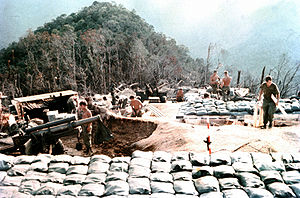
A fire support base (FSB, firebase or FB) is a military encampment designed to provide indirect fire artillery fire support to infantry operating in areas beyond the normal range of direct fire support from their own base camps.
Click to enlarge
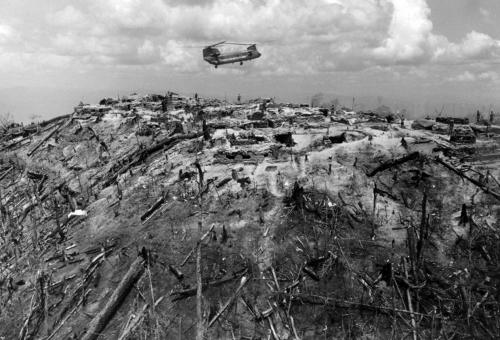
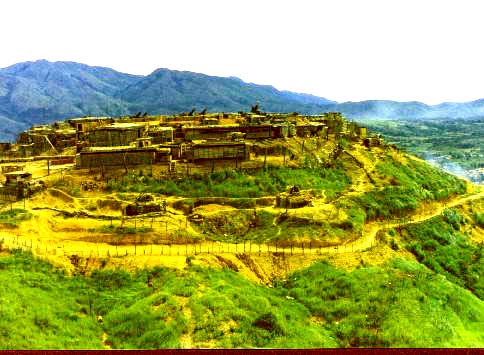
An FSB was normally a permanent encampment, though many were dismantled when the units that they supported moved. Their main components varied by size: small bases usually had a battery of six 105 millimeter or 155mm howitzers, a platoon of engineers permanently on station, a Landing Zone (LZ), a Tactical Operations Center (TOC), an aid station staffed with medics, a communications bunker, and a company of infantry. Large FSBs might also have two artillery batteries, and an infantry battalion.
Click to enlarge
A major innovation of the Vietnam War was the fire support base. Because there were no well-defined battle lines, fire support of maneuver units could not always be accomplished from secure, behind the line positions or from major base areas. Often, positions had to be secured in enemy-dominated territory.
By late 1966 the usual procedure was to establish fire support bases containing headquarters elements, medical facilities, and other support activities, as well as supporting light, medium, and sometimes heavy artillery. Setting up such bases became the routine opening phase of search operations. For example, the beginning of Operation JUNCTION CITY, 22 February-14 May 1967, included a drive by the 1st Infantry Division to open a road northward through War Zone C for the purpose of establishing fire support bases from which the maneuver battalions would operate and receive their artillery support.
Click to enlarge
These early bases were often attacked by North Vietnamese Army and Viet Cong forces, as they made ideal targets for enemy offensive actions. Eventually, because of the enemy’s inclination to attack such installations, fire support bases were established for the express purpose of decoying the enemy. In these instances, sophisticated target detection means including radar, sensor devices, and infrared night sighting devices were used to give warning of the enemy’s approach.
This combination proved to be eminently successful, and large numbers of attacking enemy forces were destroyed in several such battles at little cost in friendly casualties. The decoy concept was further expanded to include the deployment of fire support bases to facilitate screening of suspected major enemy avenues of approach.
Bob Hope – Thanks for the Memories
It has been nearly 15 years since Bob Hope left us.
I had forgotten that he lived to be 100, and also didn’t realize it has been over 10 years since he died. Always enjoyed him, his movies, and his show. He touched a lot of lives during his life.
On his death bed they asked him where he wanted to be buried and he said.
“Surprise me.”

BOB HOPE IN HEAVEN
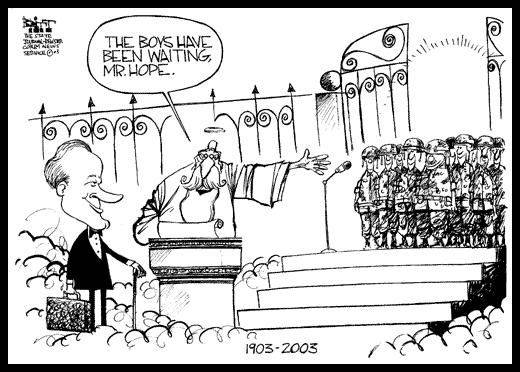
I HOPE THIS WILL PUT A SMILE ON YOUR FACE AND IN YOUR HEART. This is a tribute to a man who DID make a difference. Continue reading
Wannabe Poser
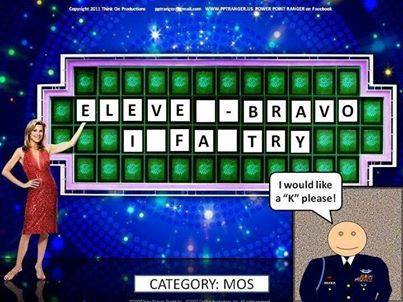
There has been a lot in the news lately about ‘Stolen Valor’. That is when people say they have served in the military and have received medals when they never served or earned. Most say they are combat veterans.
So how do you spot them?
Here is one way:

Mao Guerilla Tactics and Spider Holes
The Viet Cong used tactics pioneered—or at least used effectively—by Mao Zedong and the Red Army in China in the 1920s, 30s and 40s. Mao was a great spokesman for guerilla tactics. “The guerilla,” he wrote, “must move among people as a fish swims in the sea.” He said guerilla tactics are what “a nation inferior in arms and military equipment may employ against a more powerful transgressor.” On guerilla tactics themselves, he wrote:. “They consist mainly of the following points: Divide our forces to arouse the masses, concentrate our forces to deal with the enemy…Arouse the largest number of the masses in the shortest possible time.”
The Red Army had a great deal of success by following tactics outlined in the following slogans: “When the enemy advances, we retreat. When the enemy halts and encamps, we harass him. When the enemy seeks to avoid battle, we attack. Whenever the enemy retreats, we pursue.” The highly mobile Red Army attacked quickly with a sudden concentration of force and then quickly dispersed after the attack was over.
Large battles against forces that outnumbered them were avoided at all costs. Communists in unfriendly territory operated underground and in cells and through united front operations. When a military operation was taken it aimed to follow classic Maoist insurgency theory: overrun police outpost and remote military bases; let the state overreact with human rights abuses; capitalize on the resulting public anger over the abuses to gain support and win new recruits.
Mao was not a great military tactician but he was able to surround himself with talented military minds. He also realized that one of the greatest underutilized military assets was women. Jiang Jee was young female revolutionary who was killed in fighting the Nationalists and made into a martyr.
The North Vietnamese employed spider holes in Vietnam War. “It was very common for Japanese troops to dig very small, one-man concealed foxholes,” William L. Priest, who wrote Swear Like a Trooper: A Dictionary of Military Terms and Phrases, told the Washington Post. The man in the spider hole would wait for an enemy soldier to pass by and then would pop up, often shooting the soldier in the back. “It’s a suicide mission,” Priest says. “Take out as many men as you can from behind before you’re taken out.” The phrase was also used in Vietnam to describe similar underground sniping holes used by the Viet Cong and North Vietnamese, according to the US army Military History Institute. [Source: Washington Post]
 Charlie Company Vietnam 1966-1972