 Bud Roach with the most interesting man in the world. He said he doesn’t drink beer very often but when he does it is at Tulsa, OK with veterans from C/1/22.
Month: April 2013
Vietnam War And The Zippo
Vietnam War And The Zippo
Zippo lighters have played an important role in almost every war since World War II. They have been used in many ways including, warming hands, starting campfire, providing light and even deflecting a bullet or two. Zippos were commonly referred to as “trench art,” some servicemen used their lighters as a drawing board to convey their feelings and decorated their lighter cases with hand-etched design. Continue reading
Who is Kilroy?
He is engraved in stone in the National War Memorial in Washington, DC.
It’s back in a small alcove where very few people have seen it. A bit
of trivia – even if you never heard of Kilroy before.
For the WWII generation, this will bring back memories. For you younger
folks, it’s a bit of trivia that is a part of our American history.
Anyone born in 1913 to about 1950, is familiar with Kilroy. We didn’t
know why, but we had lapel pins with his nose hanging over the label and
the top of his face above his nose with his hands hanging over the
label. No one knew why he was so well known, but we all joined in!
So who the heck was Kilroy? Continue reading
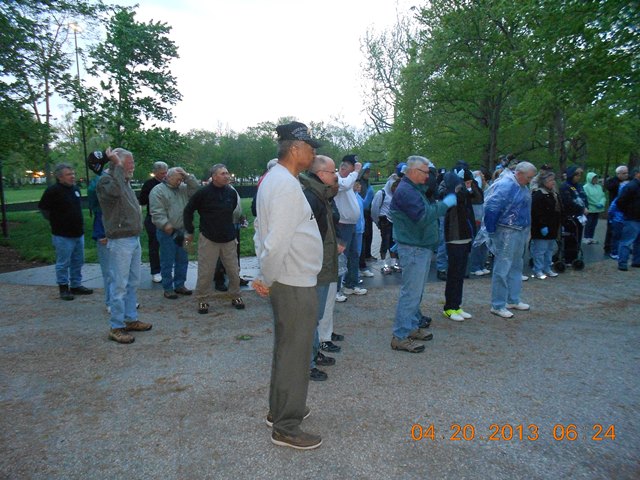
Washing The Wall
The Vietnam Memorial (The Wall) was given its monthly bath Saturday April 20, 2013. Participating was a Vet group from Michigan and the Silver Spring, MD., Viet Nam Veterans of America including our buddy Charlie Shyab. The wall was thoroughly scrubbed and completed by 8:00am.
Here are the pictures:
The M2 Browning Machine Gun
The M2 Browning Machine Gun
The M2 Machine Gun, Browning .50 Caliber Machine Gun, is a heavy machine gun designed towards the end of World War I by John Browning. It is very similar in design to Browning’s earlier M1919 Browning machine gun, which was chambered for the .30-06 cartridge. The M2 uses the larger and more powerful .50 BMG cartridge, which was named for the gun itself (BMG standing for Browning Machine Gun).
 The M2 has been referred to as “Ma Deuce”, or “the fifty” in reference to its caliber. The design has had many specific designations; the official designation for the current infantry type is Browning Machine Gun, Cal. .50, M2, HB, Flexible. It is effective against infantry, unarmored or lightly armored vehicles and boats, light fortifications and low-flying aircraft. The Browning .50 caliber machine gun has been used extensively as a vehicle weapon and for aircraft armament by the United States from the 1920s to the present. Continue reading
Hagel Repeals Drone Service Medal
Hagel Repeals Drone Service Medal
Apr 15, 2013
by Brendan McGarry
Defense Secretary Chuck Hagel has repealed a medal created just two months ago to recognize the achievements of drone pilots and cyber specialists, ordering that a separate “distinguishing device” be used instead. Continue reading
Vietnam – The Last Days
Last Days Some of the Best Ones Die
Though few Americans were paying attention at this late stage of the Indochina War, GIs continue to be killed by enemy action around and after Jan. 27, 1973. They died in Vietnam, Laos and Cambodia.
Twenty Americans were killed by hostile action in the very last days of operations in the three theaters of the U.S. war. They represented all services. Their memories deserve to be preserved despite the rush of history.
Click Here to read the story… Then go to Page 24
SOURCE: VFW Magazine
‘Until They Are Home’
‘Until They Are Home’: MIA Mission Continues After 40 Years
Tim Dyhouse
January marked the 40th anniversary of the start of the post-war search for missing Gis in Indochina. That mission’s origins are under reported as are the earliest efforts to recover the remains of Americans from overseas wars beginning in 1898. Here is a brief recap.
THE OFFICIAL DOCUMENT that ended America’s military participation in the Vietnam War in 1973 contained a provision that supported a vital VFW priority.
Article 8 of The Agreement on Ending the War and Restoring Peace in Vietnam— also known as the Paris Peace Accords—stipulated that the former combatants would cooperate “to facilitate the exhumation and repatriation” of the remains of war dead. Immediately after the document was signed, the U.S. created the Four-Party Joint Military Team (FPJMT) and the Joint Casualty Resolution Center (JCRC) to carry out Article 8. The FPJMT negotiated details of remains recovery while the JCRC carried out the actual field work. Continue reading
 Charlie Company Vietnam 1966-1972