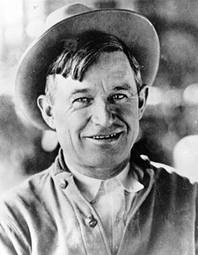
Will Rogers

Never squat with your spurs on…Will Rogers, who died in a 1935 plane crash, was one of the greatest political sages this country has ever known.

.

Some of his sayings:

1. Never slap a man who’s chewing tobacco.

2. Never kick a cow chip on a hot day.

3. There are two theories to arguing with a woman. Neither works.

4. Never miss a good chance to shut up.

5. Always drink upstream from the herd.

6. If you find yourself in a hole, stop digging.

7. The quickest way to double your money is to fold it and put it back into your pocket.

8. There are three kinds of men:

The ones that learn by reading.

The few who learn by observation.

The rest of them have to pee on the electric fence and find out for themselves.

9. Good judgment comes from experience, and a lot of that comes from bad judgment.

10. If you’re riding’ ahead of the herd, take a look back every now and then to make sure it’s still there.

11. Lettin’ the cat outta the bag is a whole lot easier’n puttin’ it back.

12. After eating an entire bull, a mountain lion felt so good he started roaring.

He kept it up until a hunter came along and shot him.

The moral: When you’re full of bull, keep your mouth shut.

ABOUT GROWING OLDER…

First – Eventually you will reach a point when you stop lying about your age and start bragging about it.

Second – The older we get, the fewer things seem worth waiting in line for.

Third – Some people try to turn back their odometers. Not me; I want people to know ‘why’ I look this way. I’ve traveled a long way, and some of the roads weren’t paved.

Fourth – When you are dissatisfied and would like to go back to youth, think of Algebra.

Fifth – You know you are getting old when everything either dries up or leaks.

Sixth – I don’t know how I got over the hill without getting to the top.

Seventh – One of the many things no one tells you about aging is that it’s such a nice change from being young.

Eighth – One must wait until evening to see how splendid the day has been.

Ninth – Being young is beautiful, but being old is comfortable.

Tenth – Long ago, when men cursed and beat the ground with sticks, it was called witchcraft. Today it’s called golf.

And, finally – If you don’t learn to laugh at trouble, you won’t have anything to laugh at when you’re old.

.

Roots of the Vietnam War

During World War II, Japan invaded and occupied Vietnam, a nation on the eastern edge of the Indochina Peninsula in Southeast Asia that had been under French administration since the late 19th century. Inspired by Chinese and Soviet communism, Ho Chi Minh formed the Viet Minh, or the League for the Independence of Vietnam, to fight both Japan and the French colonial administration. Japan withdrew its forces in 1945, leaving the French-educated Emperor Bao Dai in control of an independent Vietnam. Ho’s Viet Minh forces rose up immediately, seizing the northern city of Hanoi and declaring a Democratic Republic of Vietnam (DRV) with Ho as president.

Seeking to regain control of the region, France backed Bao and set up the state of Vietnam (South Vietnam) in July 1949, with Saigon as its capital. Armed conflict continued until a decisive battle at Dien Bien Phu in May 1954 ended in French defeat by Viet Minh forces. The subsequent treaty negotiations at Geneva split Vietnam along the latitude known as the 17th parallel (with Ho in control in the North and Bao in the South) and called for nationwide elections for reunification to be held in 1956. In 1955, however, the strongly anti-communist Ngo Dinh Diem pushed Bao aside to become president of the Government of the Republic of Vietnam (GVN).

Vietnam War: U.S. Intervention Begins

With the Cold War intensifying, the United States hardened its policies against any allies of the Soviet Union, and by 1955 President Dwight D. Eisenhower had pledged his firm support to Diem and South Vietnam. With training and equipment from American military and police, Diem’s security forces cracked down on Viet Minh sympathizers in the south, whom he derisively called Viet Cong (or Vietnamese Communist), arresting some 100,000 people, many of whom were tortured and executed. By 1957, the Viet Cong and other opponents of Diem’s repressive regime began fighting back with attacks on government officials and other targets, and by 1959 they had begun engaging South Vietnamese Army forces in firefights.

In December 1960, Diem’s opponents within South Vietnam–both communist and non-communist–formed the National Liberation Front (NLF) to organize resistance to the regime. Though the NLF claimed to be autonomous and that most of its members were non-Communist, many in Washington assumed it was a puppet of Hanoi. A team sent by President John F. Kennedy in 1961 to report on conditions in South Vietnam advised a build-up of American military, economic and technical aid in order to help confront the Viet Cong threat. Working under the “domino theory,” which held that if one Southeast Asian country fell to communism, many would follow, Kennedy increased U.S. aid, though he stopped short of committing to a large-scale military intervention. By 1962, the U.S. military presence in South Vietnam had reached some 9,000 troops, compared with fewer than 800 during the 1950s.

Source: Vietnam War. (2012). The History Channel website. Retrieved 6:22, April 6, 2012, from http://www.history.com/topics/vietnam-war.


Martha Raye

Remember Martha Raye?

Martha Raye

The most unforgivable oversight of TV is that her shows were not taped.

This is a great story about a great woman. I was unaware of her credentials or where she is buried.  Somehow I just can’t see Brittany Spears, Paris Hilton, or Jessica Simpson doing what this woman (and the other USO women, including Ann Margaret & Joey Heatherton) did for our troops in past Wars. Most of the old time entertainers were made out of a lot sterner stuff than today’s crop of activists and whiners.

The following is from an Army Aviator who takes a trip down memory lane:

It was just before Thanksgiving ’67 and we were ferrying dead and wounded from a large GRF west of Pleiku.  We had run out of body bags by noon, so the Hook (CH-47 CHINOOK) was pretty rough in the back. All of a sudden, we heard a ‘take-charge’ woman’s voice in the rear.  There was the singer and actress, Martha Raye, with a SF (Special Forces) beret and jungle fatigues, with subdued markings, helping the wounded into the Chinook, and carrying the dead aboard. ‘Maggie’ had been visiting her SF ‘heroes’ out ‘west’.  We took off, short of fuel, and headed to the USAF hospital pad at Pleiku.  As we all started unloading our sad pax’s, a ‘Smart Ass’ USAF Captain said to Martha…. Ms Ray, with all these dead and wounded to process, there would not be time for your show!  To all of our surprise, she pulled on her right collar and said…..Captain, see this eagle? I am a full ‘Bird’ in the US Army Reserve, and on this is a ‘Caduceus’ which means I am a Nurse, with a surgical specialty….now, take me to your wounded.  He said, ‘yes ma’am…. Follow me.’

Several times at the Army Field Hospital in Pleiku, she would ‘cover’ a surgical shift, giving a nurse a well-deserved break.

Martha is the only woman buried in the SF (Special Forces) cemetery at Ft. Bragg.

Martha Raye in Uniform

Hand Salute! A great lady…

To read more about Colonel Maggie CLICK HERE

VA Benefit Access

VA and the Department of Defense have made it convenient to secure your benefits.

Access Made Easy by eBenefits

The Pentagon and VA now allow troops, veterans, and their families and survivors ready access to information about benefits. Now you can go to a single and secure website to obtain that information, apply for benefits and perform numerous self-service features.

The eBenefits portal (http://www.ebenefits.va.gov) was initiated in March 2007 as recommended by the President’s Commission on Care for America’s Returning Wounded Warriors. It suggested a web portal to provide wounded, injured and ill service members and veterans with a single sign-on, central access point for benefits-related online tools and information.  eBenefits has continued to evolve, providing a host of resources and self-service capabilities tailored to their needs.

BASIC AND PREMIUM ACCOUNTS

The eBenefits portal can be accessed by anyone. However, users must register for either a Basic or Premium account to take advantage of all of its features.

Basic Account: With a Basic account you can view benefits information and customize it to your particular needs and preferences. It can be used to calculate retirement and insurance needs based on your current situation.

Premium Account: With a Premium account you can access the status of pending disability claims and appeals, payment history and some military records, such as a DD-214 form.

There are online courses for the Transition Assistance Program, too, that allow transitioning service members and veterans to explore VA benefits at their leisure.  You also can apply for Veterans Group Life Insurance, and—based on eligibility—access Tricare, your disabled civil service preference, commissary, service verification and benefit verification letters using the Letter Generator. Hearing aid batteries and prosthetic socks also may be ordered through eBenefits. 

IN THE FUTURE

Future enhancements include partnering with veteran service organizations (VSOs). This collaborative effort will allow veterans to obtain their Premium-level eBenefits account through their local VSO, as well as complete and submit VA Form 21-22, Appointment of Veterans Service Organization as Claimant Representative, online.

Other planned enhancements include an improved online application process for benefits, making it easier to manage the list of dependents claimed on a veteran’s profile. You also can check the enrollment status of education benefits under the Post-9/11 GI Bill. The key to unlocking all of these features is obtaining a Premium-level account.  With each quarterly release of eBenefits, new tools and services are made available. More information on eBenefits can be obtained at www.ebenefits.va.gov.

SOURCE: VFW Magazine, January 2012

Casualties by State

CACCF Record Counts by State Home of Record

State Home of Record Number of Records
Alabama 1,207
Alaska      57
Arizona    623
Arkansas    588
California 5,573
Canal Zone       2
Colorado    620
Connecticut    611
Delaware    122
District of Columbia    242
Florida 1,952
Georgia 1,582
Guam 70
Hawaii 276
Idaho 217
Illinois 2,934
Indiana 1,532
Iowa 853
Kansas 627
Kentucky 1,055
Louisiana 882
Maine 343
Maryland 1,014
Massachusetts 1,323
Michigan 2,654
Minnesota 1,072
Mississippi 637
Missouri 1,413
Montana 268
Nebraska 395
Nevada 151
New Hampshire 227
New Jersey 1,484
New Mexico 399
New York 4,121
North Carolina 1,609
North Dakota 198
Ohio 3,096
Oklahoma 988
Oregon 709
Pennsylvania 3,144
Puerto Rico 345
Rhode Island 207
South Carolina 896
South Dakota 193
Tennessee 1,291
Texas 3,415
Utah 366
Vermont 100
Virgin Islands 15
Virginia 1,304
Washington 1,050
West Virginia 732
Wisconsin 1,161
Wyoming 120
Other (non-U.S. home of record) 121
Total 58,193

Record counts provided for informational purposes only, not official statistics

Dennis Jones Located

After 10 years of searching for Dennis Jones we finally located him.  After we posted the story about Dennis during Tet in Kontum when he pulled an NVA soldier through a window, Bud Roach suggested we contact the local newspaper in Pocatello, ID where Dennis was from.  We sent the “Ivy Leaf” article to the newspaper and after a telephone conversation with the reporter a news item ran in the Idaho Standard Journal recently as follows:

Heroic Vietnam veteran sought

Poky native served from 1967 to 1968

BY JIMMY HANCOCK

jhancock@journalnet.com

Since members of his outfit in Vietnam began holding annual reunions about 10 years ago, Fred Childs says attendance has grown more than 10-fold.  But there’s one person the group is still trying to track down. He’s the solider who braved a hail of bullets and knocked a Viet Cong solider cold with one punch.

 “We haven’t had any contact with Dennis (Jones) since Vietnam,” said Childs via telephone from his Pasadena, Calif., home. “We just have not been able to locate Dennis.”   The only thing Childs really knows about Jones is that he was originally from Pocatello.

That first reunion of men from the 1st Battalion, 22nd Infantry, 4th Division who served in Vietnam from July of 1967 to August of 1968, consisted of five guys, Childs said. This year, at the reunion planned for June in San Antonio, Texas, he’s expecting 60 to show up.  Each year, Jones is a topic of conversation. And each year, no one knows anything new about where he is.   Childs says there weren’t many ways that Jones stood out. In fact, he says most of the men in the outfit, which was in a forward area much of the time, were pretty much all about business.

But there was one thing about Jones that made him legendary — something he did that even caught the attention of the U.S. Army’s journalists.

According to the story, Jones rushed an armed member of the North Vietnamese Army who was continuously firing at his outfit.   “It was during the Tet Offensive in February of 1968,” Childs said. “We were in a compound in Kontum where there used to be an old language school.”   The NVA had overrun Kontum and Childs and his comrades were sent there to clear the opposing forces out of the area. They were dropped into Kontum on Feb. 1, 1968, and the following day were trying to make a sweep through the old language school.

Childs said there was a sniper in the steeple of a nearby church who was shooting at them, another NVA soldier in a building shooting at them through a window and several others in a nearby field.   Although they had managed to kill the sniper, and were taking fire from those men in the field, Childs says it was the NVA soldier in the building who was pinning them down.

“He just kept firing at us through a window. No matter if we fired back, he just kept firing,” Childs said.

 At some point, Jones decided enough was enough. He decided someone had to do something.   “All of a sudden he just took off,” Childs said of Jones. “He just got up and ran across the compound.”   It was about 50 meters, or 165 feet that Jones ran to reach the NVA soldier, and when he did, there was no hesitation.   “He pulled this guy out of the window and hit him,” Childs said.

In a story forwarded via email by Childs that was written about the incident at the time it happened, a fellow soldier Roger Ziegler, is quoted as saying that Jones, “pulled this North Vietnamese Army soldier right through the window and bagged him with a good hard right.”   Looking back on the incident, and remembering Jones, Childs said it was something you could see Jones doing, but not something he ever did with the exception of that single incident.

Also quoted in the story is a J.R. Farmer, another member of what is known as “Charlie Company.” Both Farmer and Ziegler, Childs said, died three days later during another battle in Kontum.  [Farmer is still living, Roger Ziegler KIA  4/27/1968 and Gary Campen quoted in the story KIA 2/5/1968]

Childs is hoping Jones himself, or someone who knows him, or knows of his whereabouts, will reach out to him. He has a website dedicated to Charlie Company, which he says served continuously in Vietnam from 1966 to 1972.   The website, charliecompany.org, is filled with pictures of and stories about some of Charlie Company’s Vietnam veterans. Childs can be reached through that site.

Now for the rest of the story…

We received 5-6 responses from this article which I forwarded to Bud.  One of them was from Dennis’s daughter.  Bud contacted her and obtained the telephone number to contact him.  After talking to Dennis, Bud invited him to our reunion.  Dennis will be there.

Mission Accomplished.  Hoorah.